


Well, it’s nothing short of sensational that the act of thinking has become so popular.
Sometimes it spins like a washing machine on espresso, but hey — at least the system’s running.
Most importantly, thinking has been granted absolute freedom.
The synapses are on day pass.
In principle, anyway.
There’s just one tiny catch with free thinking:
Once thoughts turn into full sentences or even slogans, they’re only one step away from becoming public opinions.
Well look at that — what a wonderfully free world we live in.
Thoughts need fresh air and open space — they love to fly around and bump into open ears.
Some ears are quite happy to catch them, hoping for a little grain of wisdom in the mix.
And when someone takes the time to wrap those thoughts — the good, chewy ones — into a story, people listen.
Humans love stories, especially when they capture life’s moments with a wink and a well-turned phrase.
But some stories tell the wilder side of thinking —
that restless wish to let thoughts run free, only to try and chase them back in again.
A quick glance at world history over the past hundred years (or more) shows what happens when a thought gets legs.
Written or spoken, ideas have a habit of changing the course of humanity.
Every revolution, every revelation began with one — or a thousand — thoughts.
Motto: “Once upon a time, a thought went on a journey.”
Thousands of years ago, guys like Socrates, Plato, and Aristotle hung around ancient Greece doing one thing all day: thinking.
To make their hobby sound more respectable, they called it philosophy.
They didn’t lay golden eggs, but they did lay the foundation for Western thought.
What they didn’t know: their ideas on ethics, politics, and metaphysics would keep the wish to think alive for millennia.
A couple thousand years later, a young man named Immanuel Kant picked up the torch.
He became a master of deliberate thinking.
Working on his Critique of Pure Reason, he revolutionized how humans understand knowledge and ethics.
Modern philosophy owes that man a lot.
Then there was Copernicus — the stargazer.
He dared to think: maybe the sun doesn’t revolve around the Earth after all.
Boom — instant controversy.
His theory shattered geocentric wishful thinking and launched an age of scientific discovery.
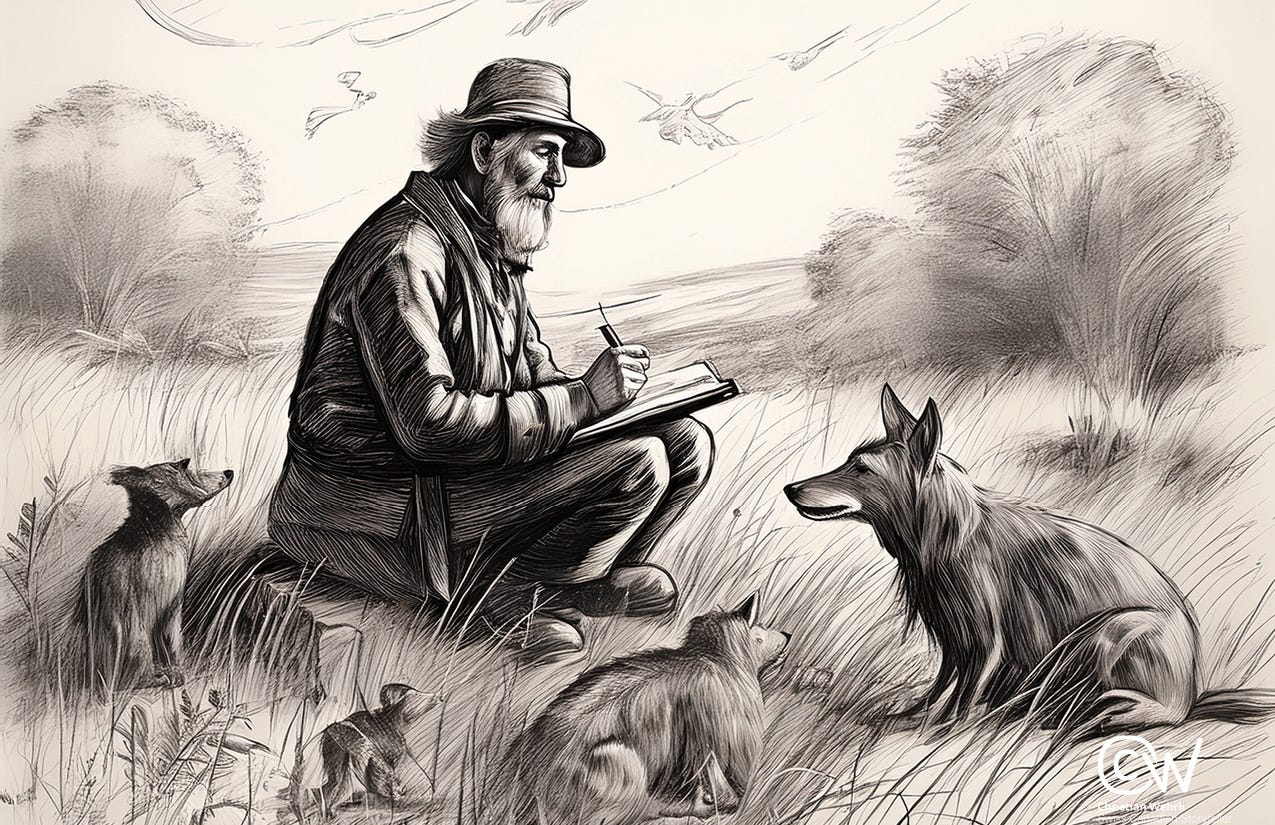
Charles Darwin took thinking out to nature — sketchbook in hand, pondering the origin of species.
His habit of observing and scribbling changed how we understand life itself.
Across the Atlantic, Thomas Jefferson had his own thoughts:
Society needed new ideals — liberty, equality, and democracy.
Those ideas sparked a declaration and built a nation.
Solid thinking, Tom.
And what about Tim Berners-Lee, who dreamed up the World Wide Web?
Without him, would we be calmer, saner, maybe even better read?
Now there’s a thought.
Either way, his invention radically changed how we talk, trade, and think as a species.
Hold on — I’ve got a few thoughts of my own knocking to get out.
How radical would it be if humanity once again saw itself as one community —
where every person, without exception, has the right and the wish to live a fair, thriving, and fulfilling life?
Too radical?
Ursprünglich erschienen auf swisschris.ca