


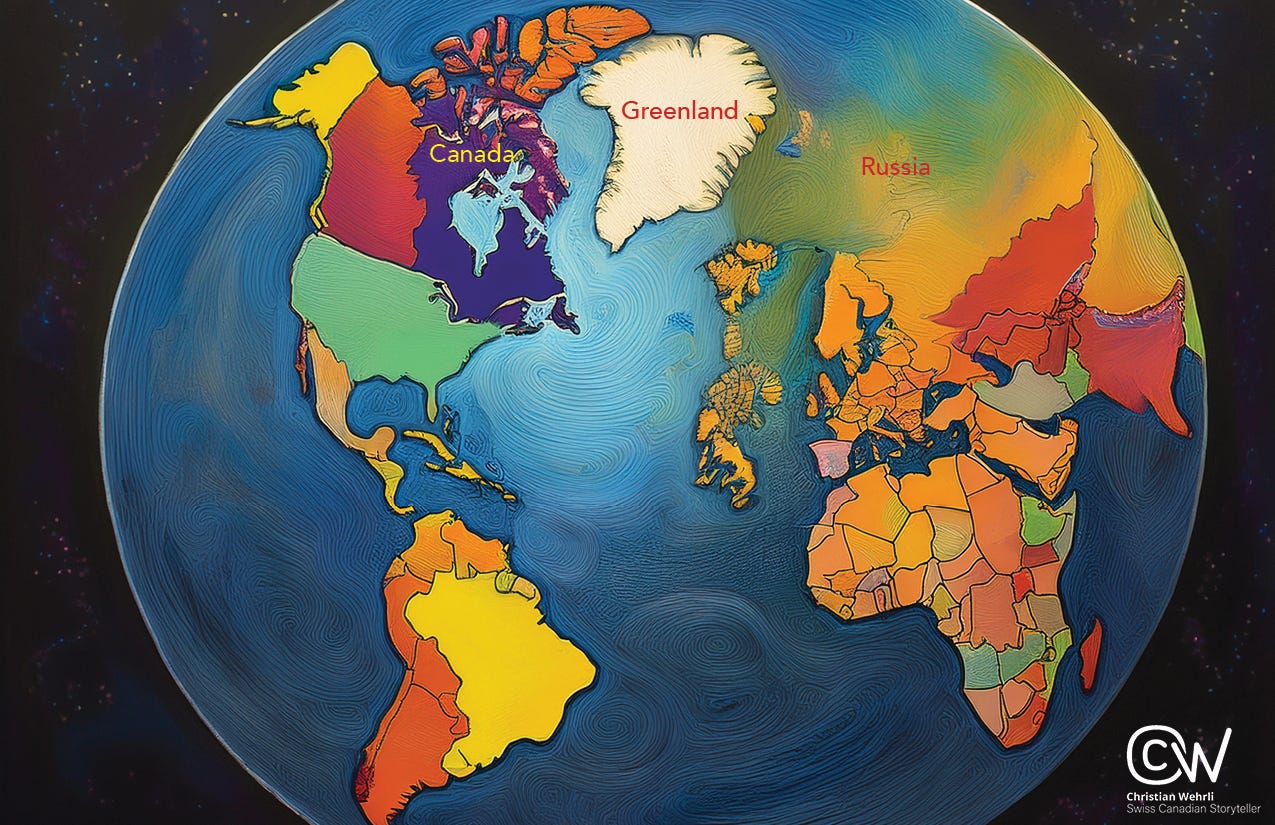
Now, imagine taking a drawing compass and sweeping a great circle around this alluring blue sphere we call Earth.
That circle cuts across massive stretches of land — territories belonging to several nations, surrounded by endless water.
For Canada, this geography makes it a “three-coast nation,” giving rise to that familiar phrase:
“From coast to coast to coast.”
The Atlantic in the east, the Pacific in the west, and the Arctic Ocean in the north.
The Arctic Circle itself sits at 66° 34′ north latitude.
So who falls inside this imaginary ring?
It’s quite the gathering in the cold: Canada, of course, alongside Greenland (which belongs to Denmark), the United States with Alaska’s icy tip, and across the Pole — the vastness of Russia.
Further south, the circle brushes Norway, Finland, and Sweden.
The Arctic, and the circle that defines it, have drifted back into public conversation.
In Washington, voices have grown louder about influence and presence in the North — even reviving old notions about annexing Greenland.
Why now?
From a Canadian perspective, the Arctic represents sovereignty and security.
The Canadian Armed Forces make that point visible through regular northern operations.
But the North is far from empty — it’s home to vibrant Indigenous communities whose self-determination and political participation shape the Arctic’s present and future.
And then there’s the Northwest Passage — that classic, enduring debate.
Canada considers it internal waters, fully under national jurisdiction.
The United States argues it’s an international strait, where transit rights apply.
That disagreement remains unresolved.
What drives the renewed urgency around the Arctic is climate change.
Longer ice-free seasons bring more ships — and with them, more risk.
The question of responsibility becomes unavoidable.
The Arctic Circle itself isn’t a border — it’s a reminder.
A thin line on the map that quietly says: from here on, things get serious.
Not because of the cold — but because of competing interests.
In the end, what matters are rights:
Who can fish, drill, sail, or rescue?
Those questions aren’t answered by latitude, but by international maritime law.
For Canada, that reality is embodied in the Northwest Passage.
Ottawa insists it’s Canadian inland water; others — especially the United States — call it an international waterway.
It’s not a fight over ice.
It’s a debate over rules.
At the same time, people live there.
Inuit communities aren’t extras in a geopolitical drama — they are active participants.
Their permanent-participant status in the Arctic Council is both politically smart and globally unique.
And then there’s the climate crisis: less ice, more traffic, more tension.
The circle is becoming a stress test for international cooperation.
In short:
The Arctic Circle doesn’t divide nations —
it divides myths from responsibility.
Ursprünglich erschienen auf swisschris.ca