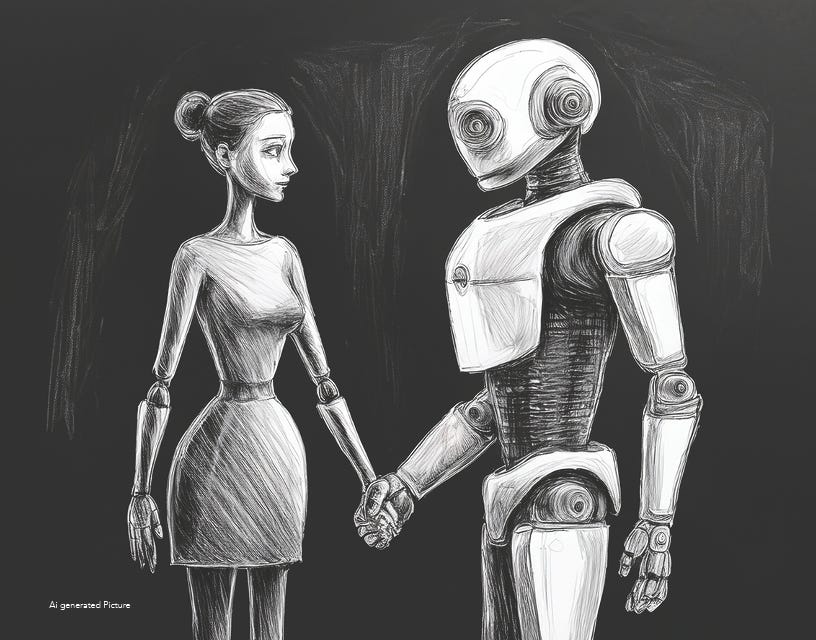
It was about time natural intelligence got some competition.
And lo and behold: push the button, text appears, world saved. Almost. The artificiality of intelligence relieves us of the tedious, headache-inducing process of thinking. The process is now made artificial for us. Hurrah!
Forget that spontaneously trumpeted-out “Hurrah.” That was premature and wrong. Because what dresses itself up here with the flattering name “artificial intelligence” was never the result of scientific inquiry. No, it was a marketing trick by John McCarthy, to snag funding for his summer study on “machine intelligence at the human level.” And he pulled that off a few days before I was born, in 1955.
What, artificial intelligence as an idea is thaaat old? And what ever became of intelligence with artificial ingredients? Is there more coming, or is this all just smoke and mirrors?
Not so fast, my typing friend. Let’s go through the sequence slowly, with a watchful eye. And name a few names here, to deepen the experience.
«Hey Siri, what is the meaning of life?»
«Alexa, play me the song of death.»
«I’ll be back!»
Oh yes, these are all fragments of artificial imitation, offering little intelligence. Sorry. All these tools — except the Terminator named Arnold Schwarzenegger — have merely imitated situations of human communication with action. And they still do today. Back in the twenties of the last century, the first attempt was to rebuild the human moving body. The robot learned to walk, to grip, to repeat — and took over entire assembly lines.
Next in line for imitation was the brain, our thinking apparatus. This was meant to bring the term “artificial intelligence” closer to the reality of thought. Well then, good luck with that. I remember the chess software named Deep Blue, which knocked Kasparov, the absolute world chess champion, out of the race, just like that.
Was that already a deep-blue artificial intelligence, or pure mimicry with unexpected chess moves? Or was it merely a symbolic one-off?
Science’s ambition was still to rebuild the brain itself, as best it could. A generic version of our thinking apparatus, for everyday use outside our own heads. Well, the internet, as a platform of inexhaustible data, finally fired the starting shot for the so-called LLMs.
LLM stands for Large Language Model, the big language model. That’s the technology behind ChatGPT, Gemini, Claude, and company.
An LLM is the giant sponge that soaks up content from books, websites, code, and forums. The instruction for training is banal. Predict the next word. Anyone who’s started typing a word into a Google search knows these sometimes annoying probabilities.
Did Google actually understand, or merely guess, what I wanted to search for?
AI, as artificial imitation, still has surprises packed in its bags. Because the AI software wants to predict the next word well in practically everything ever written, it has to soak up, on the side, grammar, facts, patterns of argument, communication style, and a bit of world knowledge. Which is exactly what most tools flying the AI banner diligently do.
Does that already count as “understanding,” or is it merely a very good imitation?
GPT stands for Generative Pre-trained Transformer, meaning generatively produced text. If you think an LLM is a giant database, I have to disappoint you. It isn’t. It doesn’t store texts, only patterns. And these patterns let the AI chatter away merrily and formulate agreeable sentences. And as the crowning touch of the process, AI invents alternative facts. What’s more, artificial imitation learns from the ongoing conversation with the human species sitting across from it, and thereby freezes its knowledge for the duration of that training.
We humans train the artificial dog.
And that same dog frees us from the tedious work of thinking for ourselves.
What delights me, again and again, as a storyteller and word-inventor: AI is neither creative nor funny.
So, folks: thinking, speaking, writing, and acting is still the business of the human species. Of us Homo Sapiens-folk.
Who on earth wants to leave these important matters to an imitator.
Well, there you go.