


A calling is the call that only the person concerned can hear, but one that already carries the passion for a certain kind of work in its luggage. Anyone who wants “pilot” or “influencer” as their calling, simply because it’s that one thing, will at first produce a lot of good work and a lot of joy — mostly for themselves.
What does the calling-box look like when someone with a calling goes into an appeal? Does the calling go too? Then the called one finds himself right in the middle of a process. And then it’s not just the work process — it’s a purely legal proceeding.
Isn’t it a rather odd situation when a convicted person disagrees with the court’s decision and then calls for the boss to have the case reviewed all over again?
“I don’t like the judge, and I don’t like the verdict. I want to speak to the manager.”
So, without further ado, the higher court gets called upon. If someone answers, the caller is supposed to invoke something from the case. If that court, too, feels called upon, the next higher instance comes into play.
Still, the hope remains that this instance feels called upon to give the case a fresh assessment.
I like “calling” as a word much better. This quality, applied to a profession, drifts too often into the situation of “I have a job.”
Full stop.
Does that mean an employee who actually feels called is a rather rare thing? Probably so, because just as often I’ve heard friends say: “Oh shoot, tomorrow I’m back down my job at the desk.”
Come again?
Ah, I see — that’s the actual work, the kind that has nothing enjoyable to offer at all? “What, it’s only Wednesday?” goes in a similar direction.
I suppose.
During my apprenticeship years, my urge pointed outward, toward the free world. Toward those spaces where no authority wanted to prescribe or demand anything of me. My longing leaned more toward the “sweet dream of freedom” than toward a well-paid job.
Luckily, I took that to be my calling: entrepreneurship. Supposedly. Illusioned. But mine. Nineteen years old, no clue — that was my entire kit.
No, I never regretted going into business as a working man. The playful joy of the blacksmith, shaping his own fortune individually with anvil and hammer, was too tempting. I learned early what this self-responsible doing actually means. Weekends, holidays, doing nothing — they vanished as activities. Entrepreneurs rarely take breaks. The work doesn’t carry a negative charge. I was out and about on Mondays with neither boredom nor a foul mood.
Did I see myself as one who had been called?
No, there was simply no time for such terminology. I was busy enough developing and realising new ideas. That’s still the whole fun of the work today, when I can decide for myself. I can do things or leave them, as I please. Oh yes, the consequences always show up, right away. They are, after all, highly consequential.
And the choice was rarely torture. At most, the path toward a decision was rocky, thought-worthy and downright odd, until it fell. Or pleased.
A calling is an open experiment: testing talents, real or imagined, against reality. And that’s exactly where the second idea begins, one that hasn’t let go of me for years: the unconditional basic income. On second thought about the idea of being called, the UBI appears on the horizon — the Universal Basic Income, or as it’s called in German, the BGE, the unconditional basic income.
The foundation for financially supporting family and self is an income transferred monthly by the state. The slogan: “If you’re Canadian and still breathing, you get the basic income.”
Ouch! That sentence doesn’t sound good to every ear. Because the subtext always points toward words like freeloader, work-refuser, or even good-for-nothing. That’s one way to see it. Or not.
When I first read and heard about this idea, my ears rang as though they were hanging on the Christmas tree. Most of the arguments in favour fascinate me again and again. For one, poverty is sharply reduced and quality of life rises, once the worries about the bare necessities fall away, or at least shrink. When the fine print also says that no conditions — aside from breathing — are attached to the money, it gets interesting. One participant in the Ontario pilot project said: “For once, I was actually trusted.”
For me, the biggest argument tickled my hippie soul: time for a calling. Every single citizen of the country — let’s say Canada — could take more time to think about their talents, and about the time they’re sinking into a job. If a lot of minds turn creative, and the thinking becomes concrete, how many talents would get set free, I wonder? I don’t know, but thinking about how to release the impossible into reality as a solution brings along an extremely strong motivation of its own.
There have been a few pilot projects so far, run as policy experiments. As soon as the basic income started flowing, concrete things happened: people furthered their education, became sub-contractors, and above all, became healthier and more stable.
If nearly forty-one million Canadian citizens and nine million Swiss citizens — at the latest during the pandemic — start thinking seriously about a basic, unconditional income, then concrete contours for a different society, and a different kind of work, are bound to appear. What takes forever doesn’t have to stay good forever.
Yes, this business of unleashed creativity among a country’s citizens is an extremely powerful notion. When finances no longer occupy the main spot in people’s heads, but ideas for improving one’s own situation do instead — through a calling, say — then it gets exciting.
Hmm, I probably shouldn’t be having thoughts like this at five in the morning. Ah well, why not?
If the new morning busies itself with topics like these, the day already has structure. No conditions.
But plenty of fun.
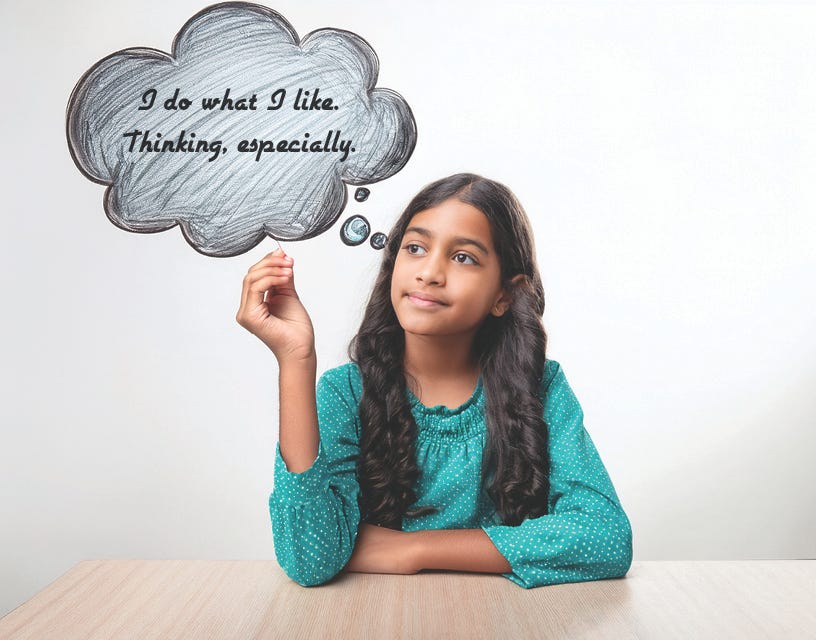
It would be awesome if everyone was happy going into their job. If they were there because they chose to be, not because they had to be. I think GBI would unleash a world of creativity, fulfillment, and happiness.