People can take the deposit money and buy a few things they badly need. Yet anyone who watches bottle collectors at work will hardly reach for the word “honourable.” Because these people depend on deposits precisely because they have nothing else left.
These people — no roof over their heads, a few possessions in plastic bags — would rather avoid the eyes of those around them. Of course it is anything but pleasant, when you happen to be homeless, to be seen as a loser, a has-been, someone pushed to the edge.
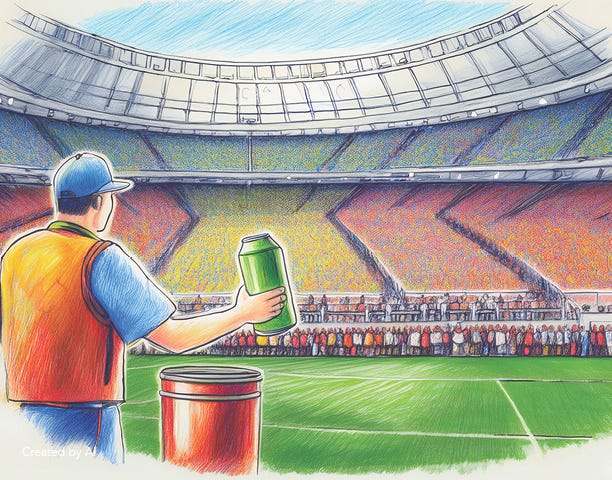
In Vancouver, the situation for these people shifted a little during the 2026 World Cup. They now wear official World Cup vests and carry recyclables. Suddenly their daily survival ritual has acquired something like dignity — and a pay stub.
During the World Cup, at least.
Is this not THE great Canadian dream, the dishwasher-to-millionaire story? Financially speaking: no. But looking at it another way, what has changed for these people is this: they and their work are now recognised and valued. Alongside their official World Cup vest, they also wear name badges. And this, even though they are doing exactly what they did yesterday. And will almost certainly do again tomorrow, after the 2026 World Cup ends.
A man in a colourful KIWI costume approached a waste bin, ready to toss his beer can in.
“Don’t throw it in there, sir,” said Daikole Frazier, smiling. “I’m a professional.”
FIFA expects the 2026 World Cup to generate roughly 13 billion dollars in revenue. Every hotdog stand owner who sold a single sausage will be sending a share of the profit to Zurich. The deposit bottles, meanwhile, get tossed aside without a second thought. Picking them up and claiming the deposit is the usual business model of the bottle collectors — those mostly invisible presences who keep the recycling cycle turning. Today, in Vancouver, they are visible. And they might even hear a warm “Thank you for your hard work.” called their way. A sentence that short can hand someone on the margins a membership card back into society.
Tomorrow, probably not.
They are not only collecting bottles. They are collecting social experiences. Some are warm and generous. Some are dismissive or unkind. But what stings the bottle collectors even more is when they are simply invisible to the people around them. That hurts.