I’m doing it anyway.
On the night of August 24 to 25, 1814 — 212 years ago now — public buildings in Washington really were set ablaze. Alongside the “President’s House,” the Capitol and other public buildings went up in fire and flame. The rumour persists stubbornly that the culprits, the arsonists, were Canadians. Well, mathematically and then historically, this doesn’t fit the real story. Because the Confederation of Canada didn’t step onto the historical stage until 1867.
The White House story back then had a few fire-hazardous forerunners that shine a different, more plausible light on things.
In July 1813, Americans come to York — known today as Toronto — and burn barracks and supplies. And since they were already in the mood for arson, a certain George McClure has the town of Newark burned to the ground on December 10 of that same year. Today that same place is known and beloved as Niagara-on-the-Lake. The residents stand in the snow, out on the street. The British — the pre-Canadians of the day — aren’t about to let that slide. So the towns of Buffalo and Black Rock have to burn for a bit too. And as these sandbox squabbles tend to go back and forth, the Americans got carried away in May 1814 with a raid on Port Dover on Lake Erie.
Carried away indeed.
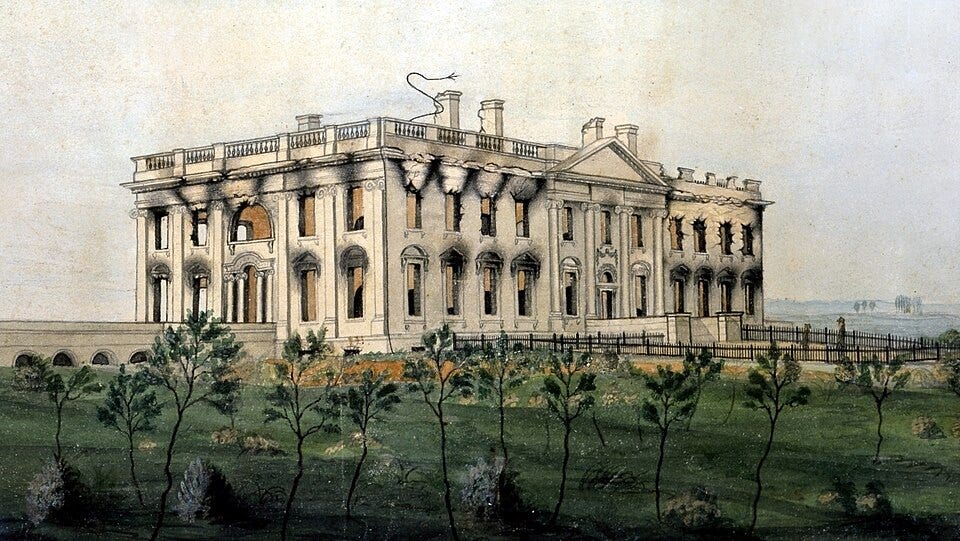
On that very same August 24, 1814, British troops under Rear Admiral George Cockburn marched on Washington and burned the President’s House to the ground. Yes, that was its name, before the rebuilt building was christened “the White House.” I’ll spare the battle itself — what remains are the anecdotes on the margins. And a few of those anecdotes caught my eye, ones I’d like to tell.
Back then, the Americans had hauled off the royal mace from York — stolen it, in other words. America took its sweet time, over a hundred and twenty years, until Franklin D. Roosevelt returned the royal artifact for Toronto’s hundredth birthday.
And then, of course, the story of the capital “C” caught my attention. The aforementioned Rear Admiral George Cockburn didn’t take kindly to the press attacking him publicly, again and again. His tender soul was wounded to its very core. Oh, isn’t that just precious. Hard to imagine any public figure in our modern age harbouring such delicate feelings.
Well, old George Cockburn vented his anger and his hurt feelings and destroyed the newspaper “National Intelligencer.” Legend has it that George instructed his men to remove the letter “C” from every typesetting case in the building. Ergo, the next bit of criticism from the National Intelligencer would come out somewhat gap-toothed.
What on earth is meant by “oburn”?
Ergo, the story from back then must be slightly corrected: “The British, in Canada, torched the White House.”
Sorry.