


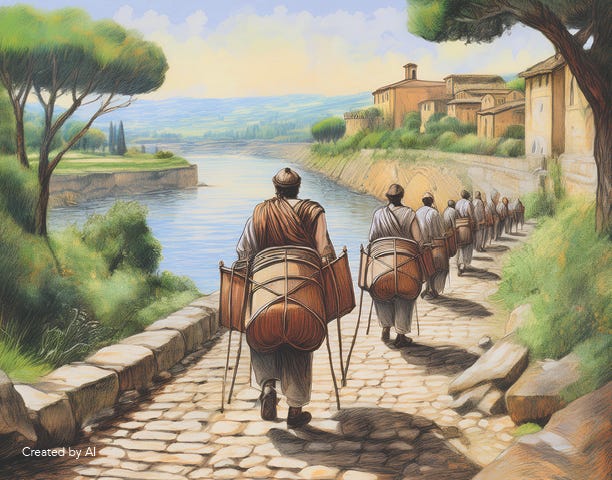
Hope is, by nature, rather sluggish about the whole thing — spending the entire day doing nothing but waiting for something, hoping it will happen. Is that applied fatalism, or simply laziness, this little arrangement Hope has made for herself?
Right, now Curiosity is wide awake and wants to know more about this phenomenon called Hope. So then, dear Curiosity — kit up. Time to do some digging.
Oh, this is already going well. What the average person and their average mind understands by hoping is that something is expected in the future. Usually something good, at that. And right there begins the disastrous — read: rather negative — business that goes by the name of Hope. He waits.
A portion of Homo Sapiens — “he” again, naturally — waits for the future to serve up exactly those expectations, to satisfy them, to be good. No, my friend, that’s not how this runs smoothly, if that’s how you’re treating Hope. Because Hope wants more than merely to keep you content. Anyone could come along — him or her — and start making demands. On the one hand, Hope puts you in a good mood. Fair enough, that’s a decent design. On the other hand, Hope is, at its core, completely unreliable. It plants itself there and nudges people into a minimal state of happiness, but that’s just a smoke-and-mirrors act. Because Hope fizzles out, vanishes from your life, whenever it hasn’t fulfilled its never-spoken, never-written expectations.
Right, that’s enough tearing Hope down. Bit rich, that. Because Hope is a tool — a piece of equipment, like a hammer, a saw, or a screwdriver. In the figurative sense, yes, of course. But a tool is only as good as the person using it knows how. You follow? Hold the hammer — or the chainsaw — the wrong way round, and you’ll know exactly what’s meant by that. Hope, as an instrument of the mind and its condition, is a tool of an exceptional class. Because it has class. Provided you don’t hold it the wrong way round.
Hope and those who carry it are doers. Not wanderers lugging uncertainty around. When Hope sets out to move something inside human minds, that is activism in practice. Because Hope puts into motion certain thoughts that weren’t visible before — not even faintly, not even through the fog. When Hope laces up its shoes, pay attention. It gets to work laying out the pros and cons, the possible and the impossible, on the table. Then comes what you might call the big spread — often containing more than enough chaos. But now things are on the table that Hope can actually work with. As a preparer, nothing more. It sorts out the things that are guaranteed never to happen. Lovely barbecue weather, world peace, or love with a warranty card, for instance.
Or so Hope suspects, at any rate. But then that same Hope flips the switch to “active.” That’s when things get dicey — and hopeful. Because the human mind has not yet been abandoned by all of them, and is only waiting for a sign. Or several, while we’re at it.
Yes, there’s still hope. And what does it look like?
I am still entirely full of hope, and I will gladly carry it around — actively — for the rest of my life. Nudging it and giving it the odd pat so it stays active. And keeps staying that way. Because Hope knows one thing for certain: if Hope always relies on a single carrier, things get tight when the last carrier dies. It stands — or sits — alone on open ground. And what does it do then? It dies.
So then: can we afford Hope?
Absolutely — and we keep the old girl in active mode at all times.
Hope likes that.
So do I.