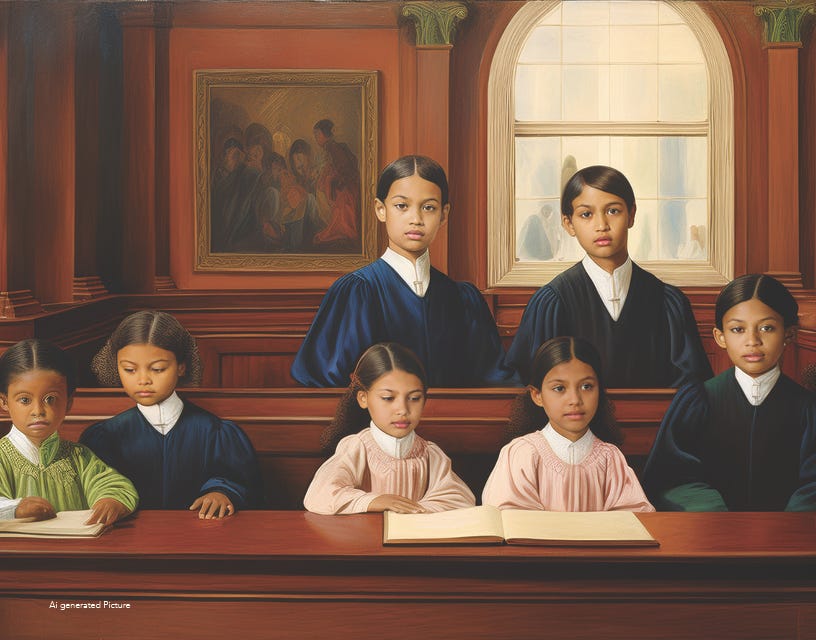
Seven years ago, fifteen young people between the ages of seven and nine wanted to know whether they have a future. Or not. They filed a lawsuit against the Government of Canada, because it was showing too little responsibility in the climate crisis. The children made clear in their claim that they are already suffering today under the consequences of climate change. In their view, the federal government had missed its own self-set climate targets — in other words, failed to keep them. This, they argued, violated their right to life, liberty, and security of the person under Section 7 of the Canadian Charter of Rights and Freedoms. The children demanded a judicially enforceable climate recovery plan that would lower greenhouse gas emissions.
Exactly one year later, in October 2020, the claim was dismissed. The reasoning? The young people’s allegations were too broadly framed and could not be put into numbers from which a law could be shaped.
Here’s the piquant part: Justice Manson found that the negative effects of climate change for the claimants, and for all Canadians, are significant — today and in the future. A judge who confirms the harm and dismisses the claim anyway. The court’s message: you’re right, just not this way.
The fifteen children of back then, and youth of today, come from Vancouver Island, across the Northwest Territories, all the way to Nova Scotia.
And they are not discouraged.
2024: the young people take the court’s hints seriously and file an amended claim in May. Ottawa announces in October that it will again seek dismissal. To avoid risking another setback, the claimants narrowed their claim — whereupon Canada dropped its motion to dismiss in December 2024; the new statement of claim followed in January 2025, and shortly after, the statement of defence.
Since then, both sides have completed the so-called discovery phase — documents, expert reports, and examinations — this past January.
And now?
The trial.
Starting in October 2026, the trial will run for eight weeks in Vancouver under the title “La Rose v. His Majesty the King.” Sounds like a Brothers Grimm fairy tale. The kind of story where someone ends up turned into a frog. Well, this is no fairy tale — it’s a file number at the Federal Court of Canada. And on October 26th, the trial begins in Vancouver. Eight weeks. Fifteen claimants. One defendant, who lives in London.
In Switzerland, the elders showed the way first. The KlimaSeniorinnen — an association of women over 64, for whom heat summers strike straight at the heart — took their case all the way to Strasbourg. In April 2024, the European Court of Human Rights ruled in their favour: the Confederation was violating their rights by not doing enough on climate protection. Parliament in Bern took offence and declared the ruling went too far. The grandmothers have the ruling. Bern has a press release.
In Canada, it’s the children. In Switzerland, the grandmothers.
So who’s missing here?
Ah yes, the middle. Between twenty and sixty-five. The ones who vote, pay taxes, live with the consequences — and can still afford not to sue.
Wide-awake, active citizens of every age are impressive, and they are the fuel of a healthy democracy.
Switzerland and Canada show what that looks like in practice.