


Who was supposed to sense it, hear it — or even pause for a moment — when people from the sciences came forward with projections of this kind? After all, we all have other things to do, better things, than to sketch out dystopian scenarios.
I have spent seventy-one years at home on what is probably the only habitable address in the Milky Way. Oh yes, I like it here very much. I have never wasted a single thought on settling down on another planet. Mars least of all. And yes, I have rarely indulged in many far-reaching reflections about imagining the future of this blue planet. What I would not have imagined: the sky outside my window. Poison yellow. Orange. As though someone had mixed the colours all wrong.
136 massive fires in northern Canada are cutting a path of destruction through the forests. Entire villages and small towns are threatened or have already burned. Thousands of people are fleeing heat, smoke, and the threat of suffocation. Homo sapiens — unbeatable, creative, intelligent — lives more dangerously than its prey ever did. And so do all the other relatives in the animal world. The air outside is no place for lungs. Not for those who can choose, nor for those who cannot. Summer in mid-July 2026 is now happening indoors, behind closed windows and doors. The concert with a Prince theme last night was postponed to today. For now.
1 November 1986. The smoky, acrid smell of the air outside right now takes me back to the Schweizerhalle chemical disaster in Basel. Nearly forty years ago, a warehouse belonging to the chemical company Sandoz caught fire, and thirteen hundred and fifty tonnes of toxic chemicals flowed into the Rhine along with the firefighting water. And the toxic fumes spread across the entire region. The Rhine ran red with dead creatures drifting through Basel. The air smelled of rotten eggs, irritated nose and lungs, settled into your clothes.
The same smell. The same difficulty breathing. But forty years later.
17 July 2026. The air reeks of smoke and the fine particles irritate nose and lungs. Not only in northern Ontario and British Columbia — Newmarket. Toronto. New York. Chicago. The same air, everywhere.
But Canada responds, of course. Canadian politics responds. In Ontario, the budget for environmental protection has been cut sharply in recent years, and in western Canada a massive pipeline is being planned. No, it won’t be delivering fresh air — it’ll be delivering the usual in fossil materials, also known as oil and gas.
And once again, it is especially the youngest inhabitants of planet Earth who are asking: “What the hell is going on?”
Yes, I feel guilty. We — the generation that is now old — should have been louder. In the streets. Not just in our heads.
Yes, with politicians and with business.
Come again — lobbyists?
Ah, right. Of course.
But today, right now, I wish those affected by the fires in Canada the safety to get themselves out.
Talk tomorrow. Act the day after. Or the other way around. As long as it isn’t, once again: nothing.
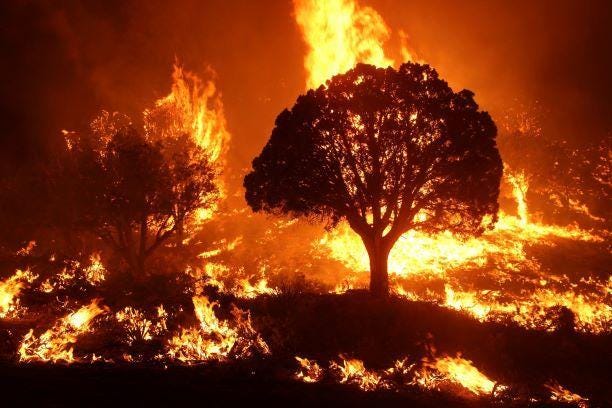
This image is a work of the Forest Service of the United States Department of Agriculture. As a work of the U.S. federal government, the image is in the public domain in the United States.