Like the other four. No one offers. No one gives. They’re waiting for the loudmouth to show he was only bluffing.
In the south of Canada sits another loudmouth, bleating into every available microphone. The microphone would rather be elsewhere. He would not. The latest announcement contains a full fifty percent. No, that’s not a reference to the truthfulness of the speech. Those fifty percent are tariffs slapped onto Canadian goods. Not by law. By decree.
And that is Canada in 2026.
Canadian businesses sit at the poker table and wait.
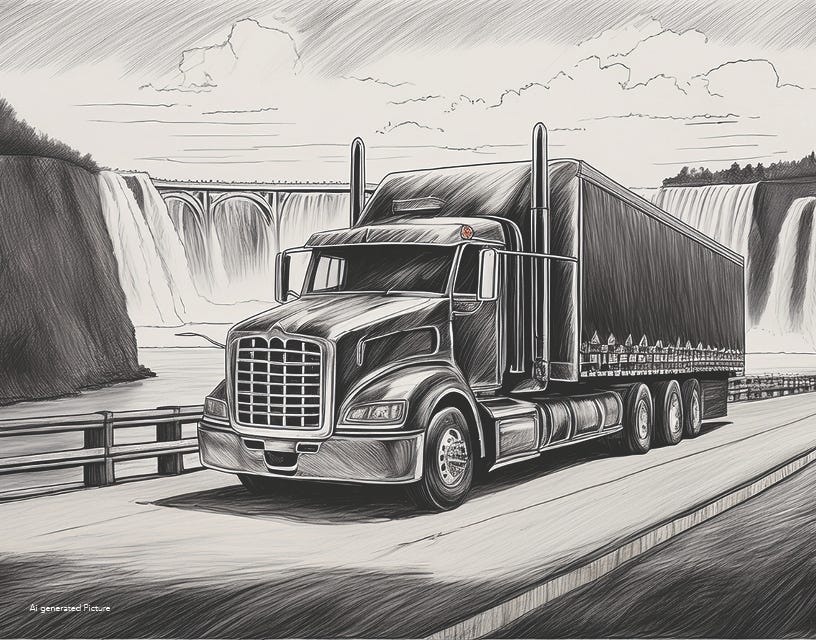
That is to say, the truck is ready, the goods are already packed, but the driver is waiting for a sign that he can go.
The sign is also waiting.
It’s possible, after all, that the threat dated August 19th was only a bluff. It wouldn’t be the first — and probably won’t be the last — hollow word from the neighbour to the south.
The Canadian export industry could still drive across the border for a few more days and make its deliveries. But it isn’t. The announcement alone seems to freeze an entire industry in place.
Is it not remarkable that an ancient concept like the threat still works? Someone utters a threat. Those threatened go still.
All it takes is a single one who undermines it. One truck that starts up and crosses the border. And acts. That’s when the threat shows what it was: air.
We all know threats. In parenting, in the office, in politics. Whether raising children, disciplining employees, or manipulating citizens — threats seem to be a proven means to an end. They are also one of the meanest ways to pursue a goal.
Threats come in many forms, and sometimes in very dim ones. When a thunderstorm threatens, that’s a warning without any ulterior motive. When a person threatens, the matter looks rather different.
Those threatened are stressed and pushed into fear. The solution, helpfully, comes bundled right along with the threat: “Give in, and you’ll have peace.” If the one doing the threatening belongs to the league of narcissists, things get uglier still.
No, it doesn’t work that way. Bullying threats are never satisfied by giving in or giving up. The hunger of the power-hungry is boundless. Whoever says no pays first. That’s the condition.
Whoever says no and doesn’t yield will feel it sharply, and soon. But the bully is the unsettled one — not the victim. That’s already something pointing in a better direction.
A long-tested means of fighting back against threats is acting together. When those threatened stand united and show some backbone, things get genuinely uncomfortable for the bullies. When nonviolent resistance, boycotts, strikes, and public protests become a regular feature on the daily stage, the support beneath the one making threats begins to crumble.
No, this path is anything but perfect. But it at least offers the chance that the threat will give way. An active, peaceful community of people can move much toward the good.
As long as it moves.
If that isn’t a border experience, what is?