The current itself can hardly help it that people react so drastically to it and to the whole circle of currents.
The impulse is simply too strong to just ignore the striking connection. Usually the inflow and outflow is regulated and follows the paths assigned to it. That old current gets lamps to glow, can throw light, and even gets trains and cars moving. Without the current, things would look even gloomier on and in the world.
Well, anyone who likes to mutter about in the dark might see the state of things more as a blessing than a dark curse. But these characters belong rather to the minority of the currentless.
When the first smartphones appeared on the market of dependencies, there arose a current of iPhone owners searching for the next outlet to recharge at.
Delightful, how panicked the faces of phone owners were out and about.
Someone hijacked the term and carried it over from the electrical into the racist milieu. A current of immigrants, Muslims, or other minorities standing by,
ready-made scapegoats.
Who invented this business of pointing the index finger at the innocent?
And who electrified such unsubstantiated claims and their headlines in the press? And with that charged up the mood of the general public sentiment, for starters?
I don’t know. I’m only guessing.
Why isn’t the term “a current of customers” judged just as negatively as other currents of people bring about? I mean, customers are interested in the product and promote the market economy.
Or something like that.
Refugees explore a better world and frighten normal citizens.
Is that how it’s meant to be understood?
Either way, these and other terms that set out to disparage a group of people annoy me. Well, I understand the reaction and the relief when index fingers shoot up and point at the guilty. Even if these people are neither related nor in-laws to the accusations.
It works anyway, because the relief is meaningful once the supposedly guilty can be named.
“Who did that?” the teacher called, balancing the bamboo stick from one hand to the other. The class of possible culprits at their desks was paralyzed.
Me too.
It did nothing for one’s good mood, having landed in a group of suspects. When a childish index finger then pointed at another kid and “He did it!” followed, we were all relieved.
The sinful scapegoat had been found.
It’s astonishing that this system of accusations is so successful. Not only among schoolchildren. Equally puzzling is how one can see oneself as a possible culprit, even though one’s conscience forcefully insists: “It wasn’t me!”
So why do I get so worked up, when it’s the others who are guilty anyway?
Well, firstly I don’t know that and can’t prove it, and secondly I don’t want to be judgemental. When many fingers point at others, the mistrust-gene speaks up and urges caution. That is, the sunny, positive view that there’s no reason for a current of criminals being shoved into the sinner’s corner without proof.
Well, last night I tinkered with the current.
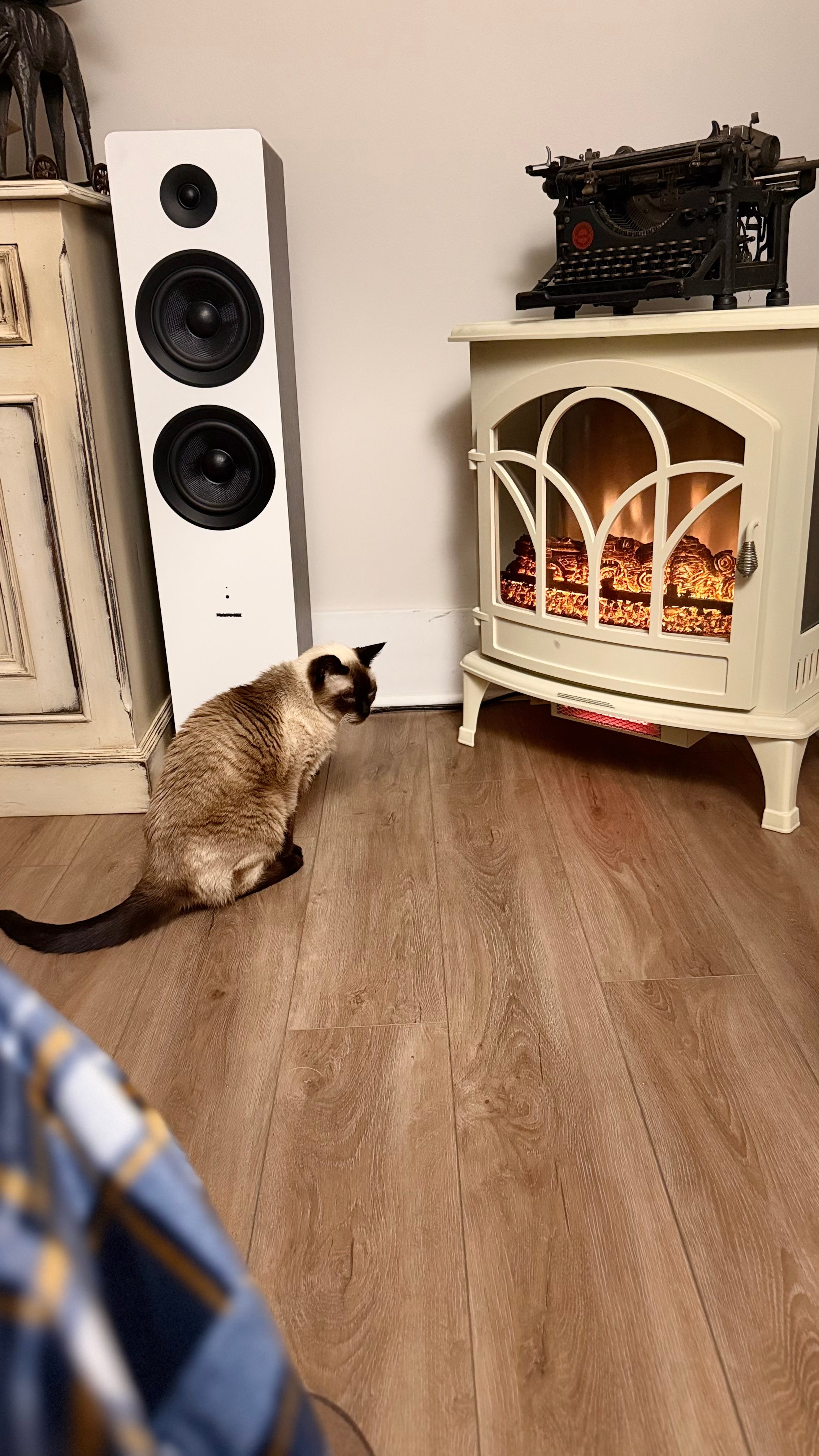
The central heating at the new place never manages the full number of degrees up to the second floor, ergo into my apartment. When Mrs. BE, my cat, demanded a second coat of fur, action was called for.
Who wants to deal with the wrath of a Siamese cat?
So I began the attempt to direct the current into my electric fireplace, while at the same time making an appeal to the ancient fuses.
With trembling, cold fingers I turned the switch and stood stock-still.
The lights stayed on, and I didn’t have to bother my neighbours over any possible surge with an “I’m so sorry!”
The current stayed constant, the fuses were assured, and the warmth rose to the second floor.
Mrs. BE said thank you.
So did I.