


The inventors of the drawer probably had exactly this in mind when they came up with the pull-outable and the push-backable.
The upward-open vessels called drawers, filled with knickknacks — Ginggernillis, in Basel German — are a helpful invention. The character of the drawer is largely liberal and entirely non-partisan. It takes in everything, lets it lie there snugly, and rarely complains about what it’s asked to put up with. It gets pushed and pulled back and forth, but it puts up with that without much fuss.
But then that one thing is needed. An urgently needed spare battery, a key, or a medication.
“Second drawer from the bottom!” comes the confident voice from the background. As it’s pulled out, some of the contents spill over the walls of the drawer-y bin, but reveal no glimpse of the thing being sought. Drawers are sneaky. They never hand over what you open them for — only what you buried in there months ago.
“The solution is stuck in the drawer.”
Ah, so that’s where the heart of the matter lies hidden. Anyone who’s ever wandered through an inventors’ fair has surely been surprised at how creative people are at inventing helpful things. And then the idea, the project, the product, disappears into one of these damned drawers. And rots there, forgotten. The problem with many excellent inventions is simple: they work too well. And what works too well is bad news for a business model that lives off repeat purchases.
The drawer snapped shut in 1949. Inside, ever since, lies a car brand that was never supposed to exist — and yet does. The Tucker 48, named after its inventor Preston Tucker, was originally called the “Torpedo.” Until someone noticed that America, in 1946, had had enough of torpedoes. So: Tucker 48. A sober name. Everything else about this car was the opposite of sober.
Preston Tucker was a self-taught man, a promoter, a visionary — or, depending on who you asked, a crackpot. He wanted to build America’s safest car. The most modern one too, while he was at it. His recipe: a six-cylinder flat engine in the rear, air-cooled. Disc brakes. Fuel injection. Independent suspension on all four wheels. A padded dashboard — as exotic then as a foot-massager in the glove compartment would be today. Seatbelts. A windshield that popped out on impact instead of shattering into the driver’s face. And then the crown jewel: a third headlight eye in the middle of the nose — the “Cyclops Eye” — that turned along with the steering. Wherever you’re headed, that’s where it looks. Top speed: 120 miles an hour. Much of this only became standard at General Motors once Tucker’s company was long gone to dust.
Only 51 units rolled out of the factory in Chicago. Tucker had sold dealership licences and issued shares before a drivable prototype even existed. A mistake? An offence? The SEC — America’s securities regulator — found: an offence. The charge was stock fraud. The trial became a spectacle; the press had made up its mind before the judge even raised his gavel. Devastating. In January 1950, the jury acquitted Tucker on all counts. Too late. The company was bankrupt, the factory empty, the dream — as they say — over and done.
Did the Big Three — GM, Ford, Chrysler — team up with Senator Homer Ferguson of Michigan to freeze out the inconvenient newcomer? Nothing has ever been proven. But the circumstantial evidence was dense enough that Francis Ford Coppola made an entire film out of it in 1988: Tucker: The Man and His Dream. Coppola knew a thing or two about men who go up against overwhelming opponents. He’d made The Godfather.
47 of the 51 Tucker 48s still exist today. Every single one is worth six figures — some, seven. Museum-worthy, roadworthy, and pricier than anything GM rolled off the line that same year.
So the drawer is shut. But whoever pulls it open finds a car that was better than its time. And a man who was right too soon.
This story sticks with me for one reason: the Tucker wasn’t just attractive. It was durable. And durability is poison for a business model that lives off spare parts. What lives long damages its own sales.
Similar thoughts practically push their way out of other drawers and into the foreground. The countless inventions for harnessing the freely available energy of sun, wind, and water are a renewable thorn in the side of the oil and gas companies. Especially the eye that’s forever squinting at the revenue and profit curve.
Again and again I find, in online drawers, astonishingly efficient inventions for generating energy from sun, wind, and water. Anyone who thinks this appetite for environmentally friendly energy supply was only sparked by climate change is a bit off the mark. The spirit of the invention drawer is much older.
Sun. 1839 — The photovoltaic effect was discovered by Edmond Becquerel in his father’s laboratory: light striking electrodes coated with silver chloride generates electrical current. This was the birth of solar technology.
1883 — Charles Fritts, USA, built the first working solar module from selenium wafers — efficiency was under 1%, but it proved the concept worked.
1954 — Chapin, Fuller & Pearson, Bell Labs, USA, found the real breakthrough: the silicon solar cell. Silicon instead of selenium meant 6% efficiency, and it’s still the basis of every commercial solar cell today.
1985 — University of New South Wales, Australia, reached the 20% threshold, and solar power, at sunny locations, became serious competition for fossil energy for the first time.
Wind. 7th–9th century — The first windmills ground their way through Sistan in what was then Persia. Vertical-axis wheels milled grain and pumped water.
1831 — Michael Faraday, England, noticed that magnets moving through copper wire coils generate current, making the electric generator possible. Without this invention, there’d be no wind turbine.
1887 — James Blyth, Scotland, built the first electricity-generating wind turbine. He powered his own cottage with it, and the neighbours thought he was mad.
1931 — The Soviet Union operated the first large turbine, 100 kW, at industrial scale for the first time.
1978 — Vestas: the Danes installed the first commercial series production of modern wind turbines, and later, in the 1980s, the first offshore wind installations too.
Water
Antiquity — Mesopotamia, Egypt, China began wheeling their water. Waterwheels have irrigated the land with mechanical power for millennia.
1878 — At Cragside, England, the first hydroelectric power plant went into operation, six years before the modern steam turbine. Water was the first renewable energy at grand scale.
1882 — Appleton, Wisconsin, USA, powered a paper mill and two houses with the first commercial hydroelectric plant.
1930s — The Hoover Dam (1936) and Grand Coulee (1942), USA, made hydropower the dominant renewable source. To this day, hydropower supplies a sixth of the world’s electricity — more than all other renewables combined.
Naturally, the curious citizen immediately wonders whether this development kept going, given today’s climate catastrophe threat? Of course it did, and how.
With the sun, perovskite-silicon tandem cells can claim the biggest leap since the Bell Labs cell of 1954. Two material layers capture a broader spectrum of light. LONGi achieved a lab efficiency of 34.85% in April 2025 (certified by the US National Renewable Energy Laboratory). Conventional silicon cells sit at a “measly” 22%.
Or bifacial panels, which capture light from both sides, harvesting reflected light off the ground as well. Photovoltaics can be built directly into buildings as transparent solar cells in windows and facades. Saule Technologies inkjet-prints ultra-thin solar films onto blinds and building envelopes. For instance.
Floating offshore turbines open up deep-water sites that fixed foundations simply can’t reach. Capacity factors run above 50% — more than some oil companies honestly show their shareholders. The first commercial projects are up and running in the UK, the US, South Korea, and Japan.
AI optimization by Google’s DeepMind shows a 20% value increase at wind farms through more efficient control of the rotor blades.
Wave energy is going commercial — CorPower Ocean installed the C4 in Portugal, the first wave energy converter at commercial scale. Its successor, the C5, is set to go online in 2026 as the first grid-connected production project.
Proteus Marine Renewables showed in 2025 that tidal power plants can achieve multi-year reliability at the megawatt scale.
Oh la la — the drawers have been partly cleared out, and they show exactly these inventions at work, in real life.
Could the nations of this remarkable planet please open a few more drawers — and give the load a decent push?
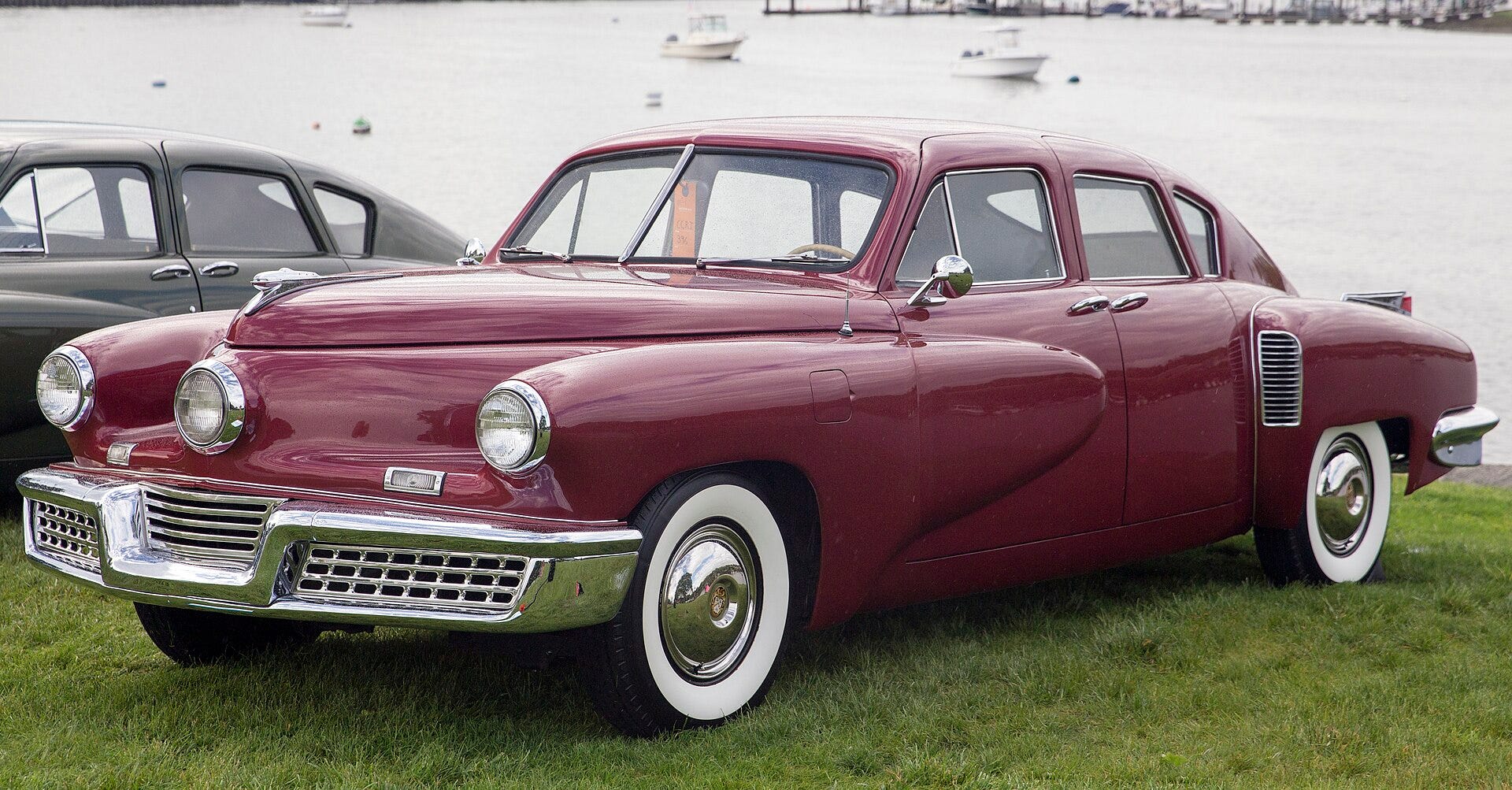
1948 Tucker Torpedo, chassis #1051, at the 2025 Greenwich Concours d’Elegance. Painted Maroon (600) over Beige (940). This car was on the production line after Tucker closed down (the last car completed by Tucker is chassis #1050) and was only completed in the late 1980s, using the chassis from car #1054 and fibreglass doors.