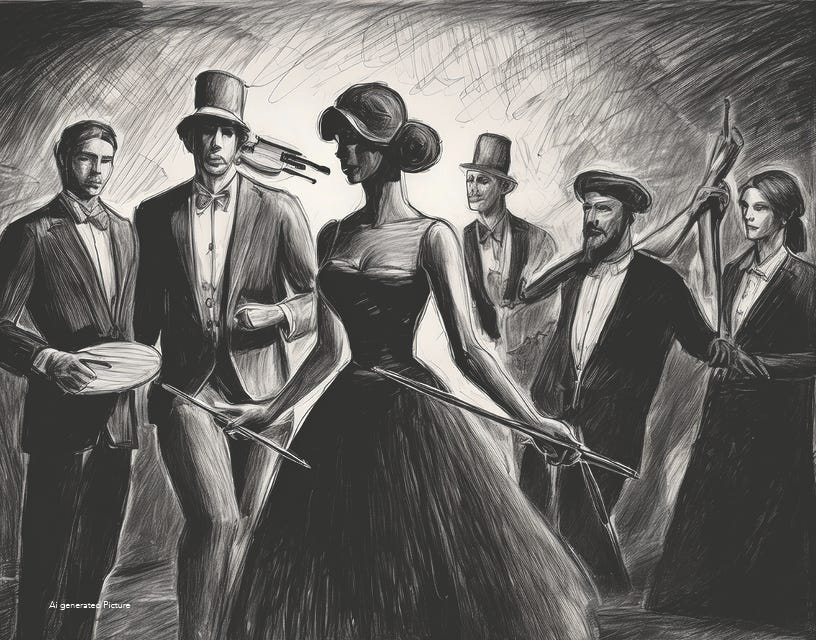
It took a while before I discovered the countless ways stories can be told. The old image of nomads passing down stories around the campfire is a prominent one. And it still holds true. With or without campfire or nomads. And yet the field is barely scratched: every mind receives stories differently, recognizes them differently.
As a lover of books and music, Kästner and Tucholsky, and later Steinbeck and Twain, swirled through my head. After the usual episode of Beatles and Stones, I discovered people like Mississippi John Hurt and Muddy Waters. The blues is pure storytelling for heart and mind. Bar by bar, twelve at a time, I came to realize, more creeping than sudden, what these blues musicians had to tell. With English films and English music too, I taught myself the Anglo-Saxon language, more badly than well. School hadn’t even bothered trying to bring English any closer to me.
Ergo, records and books kept fanning my love of storytelling, again and again. Paintings and photographs, for a long time, I did not experience as carriers of stories. They were simply pictures with scenes, faces, landscapes, or buildings, without any deeper story to experience.
Wrong.
Pictures have an incredible quality: they trigger associations in the brain — the large one or the small one. And these associations have quite the punch. Paintings and photos set off feelings I had not expected at all. Yes, tears and ecstasy were involved too. The traditional saying “A picture is worth a thousand words,” however, doesn’t make sense to me in that absolute form at all.
The first art exhibitions I visited, in local galleries in Muttenz and Basel, often struck me as something rather creepy. No, not the art objects themselves, but the visitors at the opening. I listened, secretly or openly, to the comments and speeches that talked about the objects on display. The largest share of my bafflement consisted of thoughts like “Come again?” “What?” and “Why?” No, I rarely made sense of the guesses about what the artist wanted to tell us with his object. Only bit by bit could I let myself fall into a painting or a sculpture. I didn’t care whether or what the artist had thought up while creating it — my own thoughts were the driving force. And then I suddenly saw — no, gradually saw — the stories surface. Shadowy or crystal clear, the stories emerged. And my enthusiasm for art itself made its way through.
Dance and dancers, combined with music and light, make one of the strongest impressions a stage has to offer. They are not simply bodies translating a melody into movement. It is the melody plus the dancers that tell a story. Without words. But with expression. I often visited dance schools in New York City, where ambitious dancers were drilled in ballet and jazz dance. In one of the studios, a dance teacher and a dancer were working on a choreography. I watched and listened as the two of them worked out how to translate the movements. And then I saw it: the story mutating into movement, growing more powerful by the moment.
Storytelling is more than words around a campfire. It hides in every brushstroke, every beat, every step on the stage. And they tell stories in every possible and impossible form that art has to offer.
And that is where Homo sapiens begins to glow.