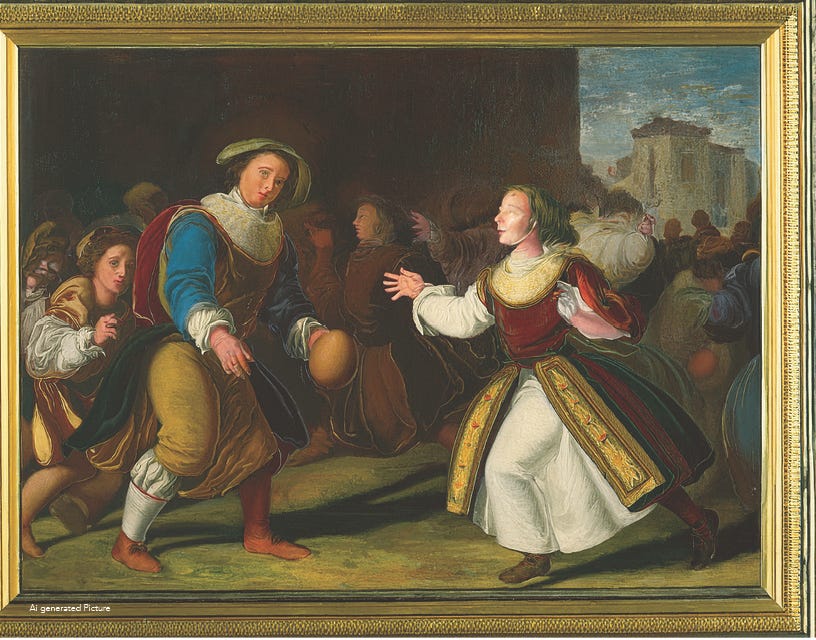
Mind you — they are actually the temporary home of a future hen or rooster. Well, most of the time it never gets that far. They get cracked into a pan before any brooding begins, or boiled too hard.
Eggs are fragile. Ergo sensitive. They come in a shell, yes — but that is precisely the problem when you go strolling across them.
Treading on eggs is a crushing business.
No, it is not the eggs’ fault at all that they are so sensitive. Evolution arranged things that way: the shell cannot bear much of a load. No hen in the world would have imagined — hens rarely do imagine — that her eggs would end up as a metaphor in the world of Homo sapiens. “Walking on eggshells” has established itself in polite society as a vivid way of describing the sensitivities of those on the receiving end.
And this phrase is not only trotted out at Easter. Because sensitivities run the full year through.
Do you know the moment — before you open your mouth or hit send — of wondering how the message will land? How great is the risk that one egg or another will suffer a crack in its emotional shell? There have always been moments, and there still are, where I think carefully about how to say or write something. But only on particular occasions, or with people who react with unusual tenderness. And it is usually tremendously tedious, because I am expected to bend myself out of shape in the process. How am I supposed to tell my partner when something about her behaviour bothers me? I do not want to be having the conversation across a tray of raw eggs.
Good heavens, communication becomes quite the ordeal. I think it is fundamentally a good thing that sending a message is preceded by some reflection. Like communication scouts, as it were. Out there with their fine antennae, reconnoitring how the message will land. In the mind and understanding of the other person. So far, so cautious. But is this now simple courtesy and consideration? Or even tact, when a text is checked for crystal-clear meaning, free of possible barbs or jabs? No — it is caution born of fear. When I show consideration for someone, I choose how to equip the message accordingly. When I am tiptoeing across eggshells as I write, I have no choice.
Why is that?
Well, when the other person reacts with extreme sensitivity in communication — for whatever reason — the exchange becomes unpredictable at every turn. And the communication arranges itself around the sensitivities of the recipient. That is how rhetoric dries out. Stories wither. And in the end no one speaks anymore — everyone just nods.
Oh yes, I am all for thinking beforehand, in any communication, about how what is said or written will be received. Not only out of caution. The image of the Emperor with no clothes keeps surfacing here. No one dares tell the old ruler the truth. He might react with embarrassment, or offence, or — heaven forbid — with something closer to reality. And so the great good of exchanging information and ideas begins to erode. If the filtering becomes so clinically pure that the content says nothing at all, what on earth are we still communicating for?
Censorship is not a Roman god.
Censorship is speech and thought, prevented.
And what does all this look like in social media? Do these rules of free expression apply there too?
Counter-question: Yes — why exactly should free speech be switched off or censored in what are often considered antisocial media? There we encounter comments of the vilest sort, which are not, however, the result of free speech, but of the deficient upbringing of hatred-driven contemporaries. Or programmed, toxic bots.
Oh yes, I am worried about our collective exchange of sentences and words. Rhetoric is an art form with variations across every conceivable possibility. Manipulators and fear-mongers stand opposite those who give courage. And as with everything: it comes down to the person — to every single one.
Keep the image, but anchor it with a half-line: “Words are knives. They spread the butter or they stab. The knife can never be held to account.”
Where was I? Ah yes — the eggs. The raw ones. I am often rather fond of them before I crack them into the pan for my scrambled eggs. For all other purposes to which raw eggs might be put, I want no part of it.
The egg would do well to keep its shell out of free speech and free writing.
And for that, it can sit and sizzle in the pan.