Gross means the total value of all goods produced. Domestic, so everything made within the country’s borders. Product means the value of all finished goods and services. That’s what the abbreviation GDP means.
Geneva looks to Halifax
On May 7 of this year, a group of UN experts presented a report on how the world should measure progress going forward. Fourteen experts, including a Nobel laureate. Thirty-one indicators. One chapter looks for examples of how a metric actually turns into action — not intention, not a statement of intention, action.
Named are the British Treasury. Scotland. Italy. Sweden. Ecuador.
And Nova Scotia.
Not Canada as a whole here, but a province of roughly one million people on the North Atlantic, whose largest city is smaller than Basel. One million people, a city smaller than Basel — and still on the list next to Sweden and Italy.
If something is precious to us
Behind this stands a non-profit organization in Halifax with the most unassuming name imaginable: Engage Nova Scotia. This is not a government body, not a ministry, and certainly not an office for anything in particular. Merely a coalition of government, business, universities, and the volunteer sector who put their heads together.
Their guiding principle, roughly: If something is precious to us, we should measure it too, without seeming presumptuous.
A sentence one should stumble over. Because it flips the usual order. Normally we measure first and then discover that what we measured matters to us — gross domestic product worked exactly that way for ninety years. Here, the fondness came first and the counting came after.
Two hundred and thirty questions in May
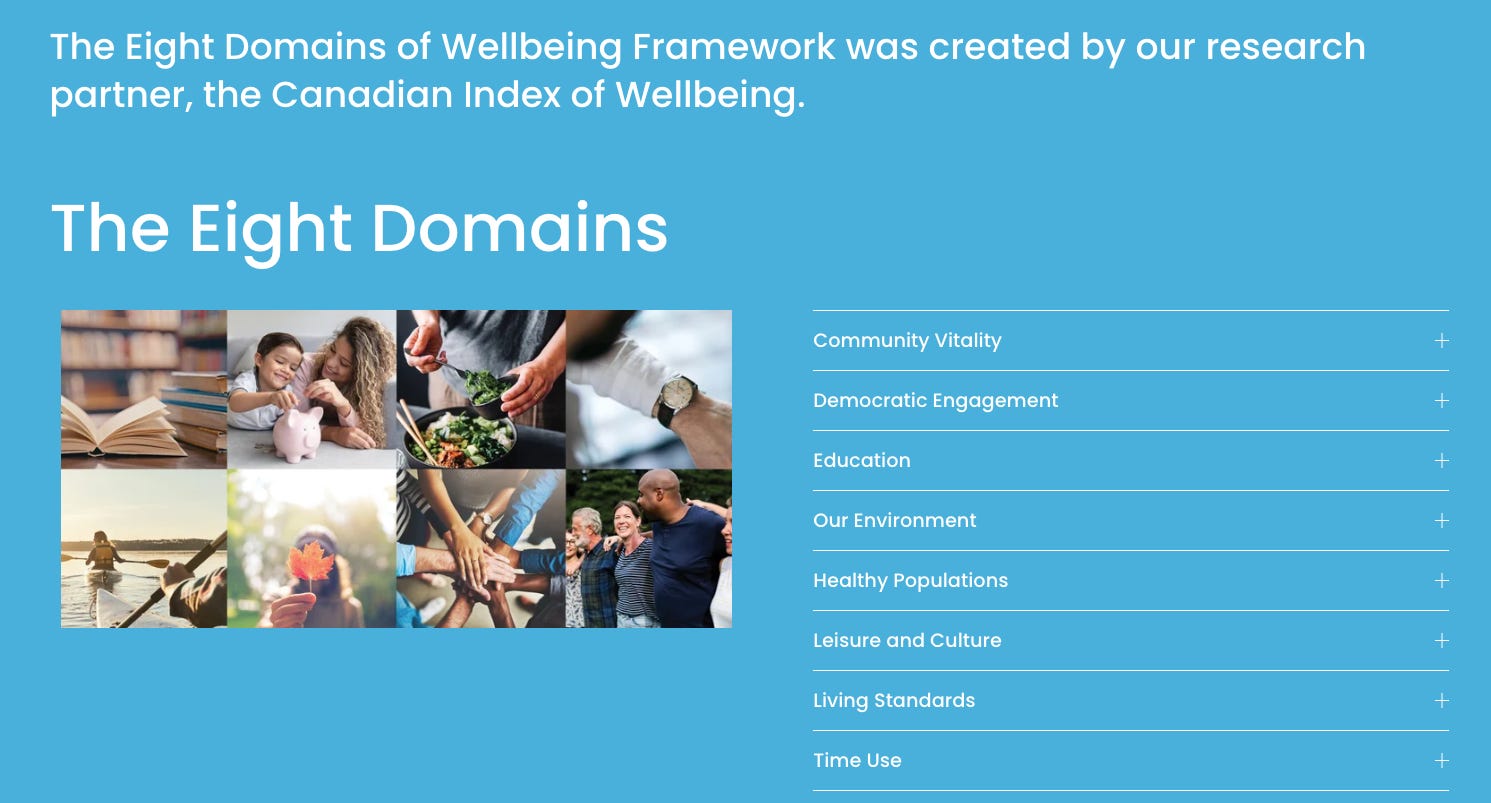
In 2018, the index came onto the scene. Twenty-one years of data, sixty indicators, eight domains, and thoroughly dry groundwork.
A year later came the survey itself. Nearly thirteen thousand people answered two hundred and thirty questions. That’s over three hundred thousand data points, and thus the largest wellbeing dataset of its kind in Canada.
The methodological partner was the Canadian Index of Wellbeing at the University of Waterloo, which has been measuring how people in this country are doing since 2011. But the thing itself was carried differently. More than one hundred and fifty volunteers from communities formed nine regional leadership teams, called public gatherings, and decided for themselves what mattered.
One hundred and fifty people. Nine teams. No mandate from above.
The six uncomfortable fields
And what did they want to know? The supplementary report names six focus areas: social isolation. Sense of belonging. Trust. Experience of discrimination. Poverty. Health.
Now set that beside what the same UN report admits about the rest of the world in 2026. Whether people were satisfied with their last encounter with government services — the global community knows this for eighteen percent of countries. Whether they feel safe walking alone at night in their neighbourhood: twenty-six percent. Data on trust and loneliness is, for now, bought in from an American private firm.
Nova Scotia had these numbers in 2019. On its own steam. For itself.
Who the answers belong to
One detail that hasn’t let go of me.
The responses of Indigenous participants do not go into the reports and analyses of Engage Nova Scotia or the research institute. They’re handed over to the data governance team of the Union of Nova Scotia Mi’kmaq. There, it’s decided what happens with them.
This is no overlookable footnote in the fine print. This is a refusal of a very old European habit — going somewhere, measuring it, taking it home, and analyzing it there. Whoever holds the numbers holds the interpretation. Here in Nova Scotia, someone else holds it.
I grew up in a country that made measuring into a national virtue. Land registry, cadastral maps, the census. Everything recorded, everything catalogued, everything tidy. The idea that the measured might decide over their own numbers — nobody ever landed on that one.
And then a pandemic got in the way
Since the start of this year, the second round has been underway. The first since 2019 — in between lay a pandemic that damaged much of what these very questions are meant to make visible.
That’s exactly where the value lies. Two snapshots of the same place, six years apart, the same questions. One will see what the pandemic damaged in people’s lives, and what of it might be repaired. The chair of the board is a former deputy chief medical officer of health for the province. She doesn’t ask which numbers one could collect. She asks which questions are needed here, and how they must be asked, so the answers mean something.
That’s the whole difference between statistics and curiosity.
The detour through Geneva
Which leaves the question of why a United Nations report was needed for me to learn of this.
Seven years this survey sat in Halifax. Two thousand kilometres from my desk, in the same country, in the same language. And I read of it for the first time in a document published in New York, meant for the world as a whole.
Perhaps that’s the real lesson. Not that the big institutions are too slow — they are, regardless. But that the useful thing is usually already lying somewhere, in a province, in a community, on a street, and nobody looks until some distant authority points a finger at it.
One wouldn’t need to invent it. One would need to count it.
And for that, as Nova Scotia has shown, you don’t need fourteen professors. You need one hundred and fifty people who find it’s worth doing.
What counts doesn’t count itself.
Someone has to go and do it.