And the sense of the combination of «gross» (great) and «artig» (well behaving) got lost in translation. Sorry!
«That was quite the grossartig performance.»
«Sorry, gross artig?»
«Well, the singer was loud, pitch-perfect, and professional.»
«OK, but she wasn’t very gross.»
«Fair enough, but wasn’t she awfully artig?»
The two critics are going around in circles. And rather missing the point when it comes to using stuck-together adjectives. Question: what’s the opposite of grossartig? Kleinunartig, perhaps — small and misbehaved?
I kept noticing this hint, that the bigness of an achievement has to behave itself to be called such. To keep its artigkeit, so to speak — to act artig, well-mannered. The bigger, the better seems to be the basic condition.
When something extraordinary is achieved, order is at work too, you’d think. But with this word it’s exactly the opposite. Achievement outside of order. Or outside the law.
As a story-collector, the stories that lie closer to my heart are the gross-unartig ones — big and badly behaved. There’s already a foundation in that, one that can be built on and might well turn out extraordinary.
In other words, a strange, unprecedented, or even cheeky story about some topic of interest.
Yes, that’s often how the news gets built and served.
The headline outruns the actual story, because it can easily point in a completely different direction. In German we’d say «Schlagzeile» — the line that strikes, the one that stays stuck in your head.
A good friend of mine once explained to me the difference between a good headline and a mediocre one. He’s a journalist, and writing headlines is his daily job.
One example has stayed with me as a headline ever since.
Two elderly ladies got into a brawl and became fodder for the press.
The headline, as I remember it:
Grosi beats Grosi half to death.
Formula One mode — time to check the fuel level of one’s own imagination. When six words can start up a whole film, somebody has done the job grossartig-extraordinarily well.
Here I want to use the word «grossartig» a little differently. The headline was «gross» in its effect — see above. And «artig» could point to the manner, the artful way, the professional command of language and effect. Or put more simply: the man knows his rhetoric.
...or other social-media techniques?
I’m not entirely sure how rhetoric can keep up anymore with the rapid image-switches and ultra-short word strings. The shorter the sentence, the more misleading it sometimes seems.
Can our senses even still follow this mini-rhetoric?
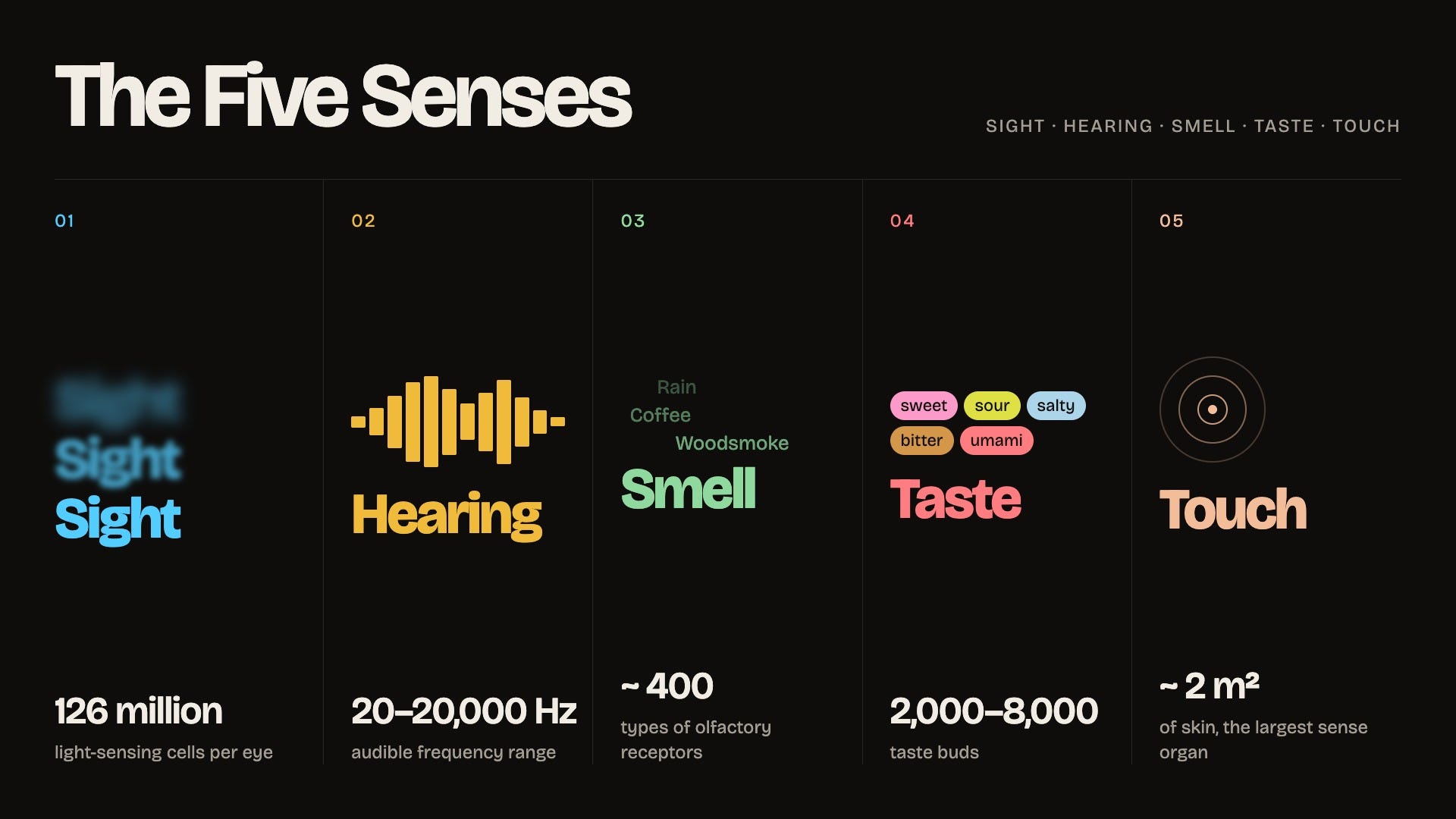
Maybe the five of them, in the whole group of senses and their perception, are a little overtaxed?
Who can render grossartig service when all the senses are running at high revs?
Is leisure still perceptible, when the ground beneath it needs to be relaxed in order to work at all?
Is «musse» (leisure) not one of the five senses, or more?
And not some chocolate dessert either? (mousse au chocolates)
I know that much.
But in one of the senses lies the willingness to surrender oneself to musse.
How grossartig is that, then?
Grosi is well again and home.