


Ideas tend to arrive vague and nebulous, and are more often than not ignored. The founding idea for a universal law of human rights was cut from the same cloth.
But this idea prevailed. First as a speech. Then as a mandate. And then: Eleanor Roosevelt.
The Universal Declaration of Human Rights turns 80. Is there reason to celebrate?
Fundamentally: yes. With gaps.
The idea for such a law sparked on 6 January 1941, when Franklin D. Roosevelt delivered his “Four Freedoms” speech before Congress. The four pillars were freedom of speech, freedom of worship, freedom from want, and freedom from fear. These four freedoms flowed directly into the preamble of the later Declaration. But first, the idea needed to take human form.
At the founding conference of the United Nations in 1945 in San Francisco, the term “human rights” was noted in the Charter. But no one had a precise notion of what it actually meant in detail. That gap was Eleanor Roosevelt’s to fill. She was appointed to the U.S. delegation and then named chair of the Commission on Human Rights.
Eleanor was neither a lawyer nor a philosopher. Many viewed this chairmanship as something closer to an alibi exercise. But this woman proved herself a formidable chair and ran her group of diplomats like a schoolroom with homework due. Sessions continued until a result was on the table.
Was Eleanor Roosevelt, then, the true architect? Not quite.
The Canadian John Peters Humphrey was a jurist from Hampton, New Brunswick. He headed the Human Rights Division of the UN Secretariat and drafted the very first version of the universal human rights document. He wrote some 400 pages, drawn together from constitutions and legal traditions from around the world. Humphrey is the largely forgotten Canadian architect of the document. But the good man kept diaries and maintained an archive, which brought his contributions to light decades later.
And then, almost in passing: Canada — Humphrey’s own country — abstained in the preparatory committee.
Come again?
Well. The reasons were federalist concerns, since human rights fell partly under provincial jurisdiction. Conservative circles also made their unease known about the universality of human rights enshrined in law.
Only in the plenary did Canada vote yes, after the foreign minister had recognised what embarrassing company an abstention would have placed them in.
Meanwhile, over two years of drafting, three fault lines ran through the document. The sharpest: East versus West. The Soviet Union at the time pressed hard for economic and social rights — work, housing, education. The West beat the drum for civil liberties. The result was the coexistence of both traditions within a single document. Revolutionary at the time. A bone of contention today.
The Declaration was never legally binding. The binding covenants followed only in 1966 and came into force in 1976. But it became the most translated document in the world and the reference point for virtually every constitution written since.
Eleanor Roosevelt herself, in 1958, answered the question of where universal human rights begin with: in small places, close to home — so small that they cannot be found on any map of the world.
Eleanor Roosevelt’s answer and Swiss author Gotthelf’s line say the same thing — a hundred years apart. “What is to shine forth in the homeland must begin at home.”
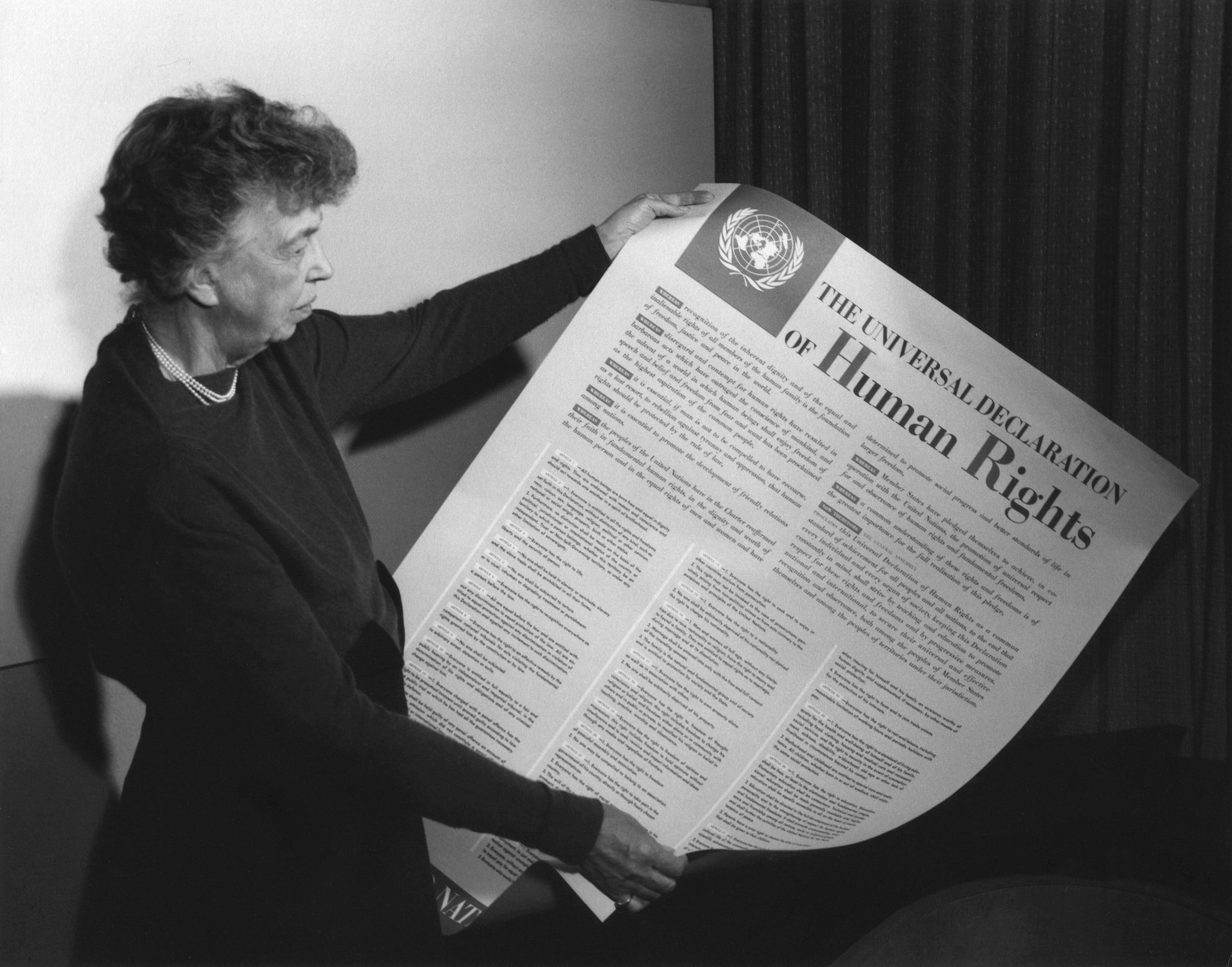
By FDR Presidential Library & Museum - https://www.flickr.com/photos/fdrlibrary/27758131387/, CC BY 2.0, https://commons.wikimedia.org/w/index.php?curid=82568079