


Husks and their effects aren’t immediately painful. They don’t attack anyone directly. They simply loiter in the vicinity of a text. And carry themselves with just a touch too much arrogance.
Husks and their fruit are the uniform compote that sells itself as rhetoric.
Oh now I recall: Buzzwords - that’s what it is.
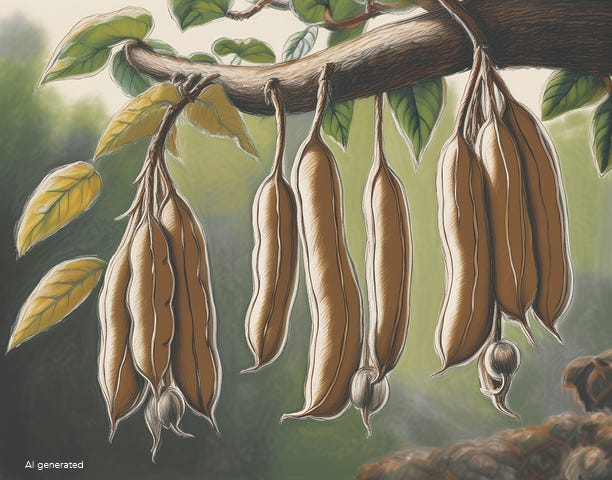
There’s something genuinely sad about this — when previously well-situated, well-regarded, well-read words allow themselves to be misused. When they suddenly notice they’ve gone hollow inside. The outer façade still stands and, at first glance, still looks perfectly intact. Which is exactly what façades love to do. Stand right there and conjure an image of harmony with themselves and with history.
The list of the hollowed-out keeps growing. The semantically deceased have landed in the word pit. What do they do there? They fill entire pages with their presence, stretching a perfectly ordinary, previously good story far beyond its natural length. The chewing gum that wants to make a text more important than it is. I mean, who still consciously registers phrases, husks like “At the end of the day...” What does that actually mean? Is it the introduction to a conclusion that rarely happens in the morning? “Basically, yes,” calls out the neighbouring husk, loudly. Which basis are you babbling about, exactly? “As previously mentioned...” — well, that’s the trouble when husks are constantly getting themselves mentioned somewhere. Oh my, one of my favourites is “If you will.” I could never make heads or tails of that one, because those three words rot away as an island of the damned inside a text. Who is the “you,” and when exactly does the will kick in?
This one husk sends me into a small private fury: “You’re not getting any younger.” I beg your pardon? Did I ever claim otherwise? For one thing, that would be a brutal interference in the life cycle, usually administered by syringe. For another, I have several entirely honest mirrors, completely filter-free. They tell me wordlessly who is standing in front of the shimmering glass.
At some point in the dim and distant past, I spent a while studying not just my own life as such, but the methodology of marketing. Above all, the copywriter’s side of things struck me as more fascinating than anything else. Because these writers share one thing: they know the rules of German grammar. Not in order to apply them perfectly, mind you — but in order to break them deliberately. With the fractured soul of the word, they want potential buyers to stumble, and in stumbling, give the poster, the TV spot, or the banner a little more of their time. They want to understand what exactly that sentence got wrong.
In the copywriter’s repertoire, however, countless sentences — some voluntary, some collateral damage — were also packaged into husks. Who hasn’t had to hear this on a customer service line: “Your opinion matters to us.” Or the banal instruction to simply think outside the box. Because “we strive for excellence” is the stated goal in countries that distinguish themselves by the complete absence of royal figures.
Husks bear fruit when the mind takes a little break. How readily I fall for exactly these sorts of platitudes when nothing else comes to me.
That’s what these fruits of poor rhetoric exploit so ruthlessly — pushing their way into the action.
Not to worry, though.
There are far worse things hiding inside husks.
Bullets, for instance.