


Her influence on human thinking immediately called a countermovement onto the table. Sharp-eyed minds spotted in Paganda a pattern of swaying opinion and attitude. They even suggested that powerful figures behind the scenes were using the system to their own advantage. An open society can still bear that much. But the moment the loudest voices show only the half and keep quiet about the whole, Paganda has won. The system itself was labelled by the Romans — who else? — as «propagare». Back then the term was still tasteless, meaning merely to spread information, or to propagate it. The later Propaganda did not yet carry the bitter aftertaste of manipulation.
At some point, the innocence of Pro and Contra Paganda was over.
Political science explains propaganda as the deliberate steering of thought. In everyday language, propaganda simply means «the other side lies.»
Once a word has been splattered with negativity, that off-flavour is nearly impossible to scrub off. So other bright minds cooked up something new, until they pulled the term «Public Relations» out of the hat.
New label, old pattern. And the other side? It has yet to find a name to this day.
Where, exactly, did the other side of propaganda get to? If Paganda was already sitting there as the middle part, why was there never a Contraganda? To the best of my limited knowledge, there has never been a «We’re against propaganda» protest in the history of rhetoric. Or of activism.
So how does this negatively charged propaganda system actually work?
Propaganda always has a message. That’s in her DNA. And this is generally how the construction of the propagandistic message works. Take a complex situation and boil it down to one common denominator. We probably all know «us and them», or «the good guys» and «the bad guys» in stories. But propaganda is nowhere near satisfied with that. As an argument, bare emotions will do just fine. Because they always land well — fear works instantly. Because pride and outrage send the blood pressure soaring, and reason only shows up afterward.
Next, the propaganda roast gets garnished with a colourful and unmistakable enemy image, one that threatens society. The crowning touch of this colourful mix is the promise of having a solution in the quiver. The hero stands ready.
What else was in the bag of tricks? Ah yes, the polish of repetition. When a message is spread and shared again and again, it eventually picks up that patina of truth. «Everyone says so» turns into facts.
And that makes every message feel familiar.
Funnily enough, propaganda doesn’t lie outright. That would be too simply knit. She simply leaves things out, and selectively weighs other points of the argument.
The technique of propaganda is simple, almost shamelessly simple — and that’s exactly why it works. First, the information needs a label, large and easy to read. Underneath follows the generalising stuff like «freedom», «homeland». Terms that never make clear what is actually meant by them. But they show their effect.
Yet the label is only the surface. The real art of propaganda is camouflage. When it is nonetheless recognised, that’s the targeted, short-term agitation — the general stirring-up, or unrest and uproar, in a society.
Camouflaged propaganda rather creeps through society. It concentrates on the long-term shaping of what seems self-evident. When the unspeakable and the repulsive become acceptable in polite company, for instance. When old dark images of National Socialism are once again openly carried out in rhetoric, then integrating propaganda has done good work.
Has Contrapaganda fallen by the wayside? Well, it was never there to begin with. Contraganda simply does not exist. Yet the astonishing thing, for a marketing expert, is that the propaganda scheme gets applied for effective communication in advertising, in sermons, and in election campaigns. And it works.
Provided the story is told well.
For a Swiss-Canadian storyteller and old hippie, this realisation is a deeply unsettling thought.
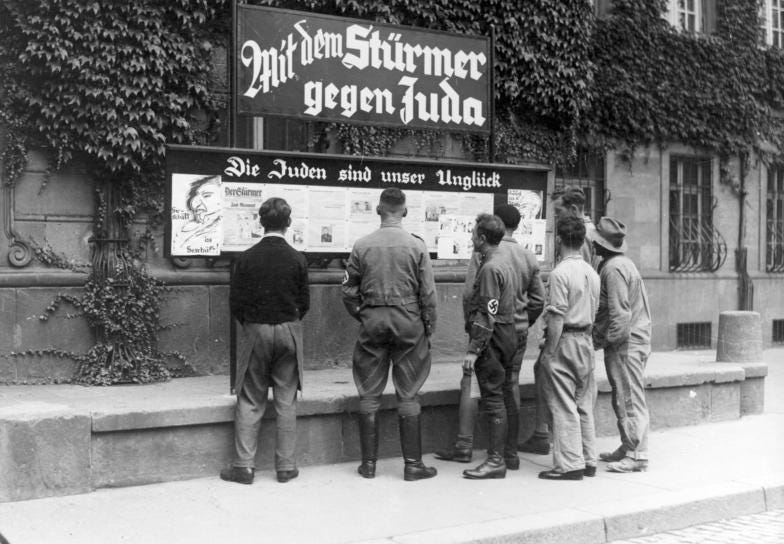
By Bundesarchiv, Bild 133-075 / Unknown / CC-BY-SA 3.0, CC BY-SA 3.0 de, https://commons.wikimedia.org/w/index.php?curid=5338071