


In the lead-up to the 2026 FIFA World Cup, a different kind of boot is being applied to a different kind of backside. At Union Station in Toronto, people without homes are being kicked out of public sight. The handsome halls of the station smell of fresh paint and good coffee. The benches where people slept last winter have been fitted with armrests that make lying down impossible. Homeless people are being dragged from bathroom stalls, beaten, driven away — just weeks before the tournament tourists are due to arrive. So reports the Globe & Mail.
One activist calls it “human whack-a-mole”: you knock them down, they surface somewhere else, you knock again. The game where you hammer moles back into their holes — except here the moles are people. People without a roof over their heads. What these people lack is rarely character. It’s simply money. The stories are similar: a first crack, then it runs through everything. Fate takes the first step — and after that, there’s seldom only one. Job loss, relationship trouble, divorce, and little prospect of pulling yourself free from the spiral — the fall to the street feels for many like the final stop. And yet it’s often only the beginning of becoming invisible.
And it’s precisely these people who are gripped, day after day, by panic and frustration — stared at by passers-by, or worse, deliberately looked through.
At some point, someone asked the obvious question: what happens if you simply pay out trust?
In Vancouver, researchers gave fifty people who had just lost their homes $7,500 each. No conditions, no vouchers, no caseworker watching every dollar — just money, and the assumption that people know best what they need.
The cliché says: it’ll end up in the next bottle. The data says otherwise. The recipients found housing again more quickly, maintained a financial cushion for over a year, and spent more on food, clothing, and rent. All told, they relieved the shelter system of roughly eight thousand dollars per person. A larger study in Denver, with over eight hundred participants, pointed in the same direction: nearly half were living in their own homes again after a year, and substance use remained unchanged — low.
But honesty requires this: Vancouver had pre-screened out people with severe addiction or mental illness. And in Denver, housing situations improved even among the group that received almost nothing — a hint that it isn’t money alone doing the work, but perhaps also the simple act of belonging. Of being seen. Cash is no magic potion. It’s more nearly the opposite of distrust.
And perhaps that is the real insight. We often manage poverty with an apparatus that costs more than the problem itself — applications, conditions, oversight, all of it signalling one thing above all: we don’t trust you to run your own life. These studies turn that sentence around. They say quietly: sometimes the most dignified help is also the most effective.
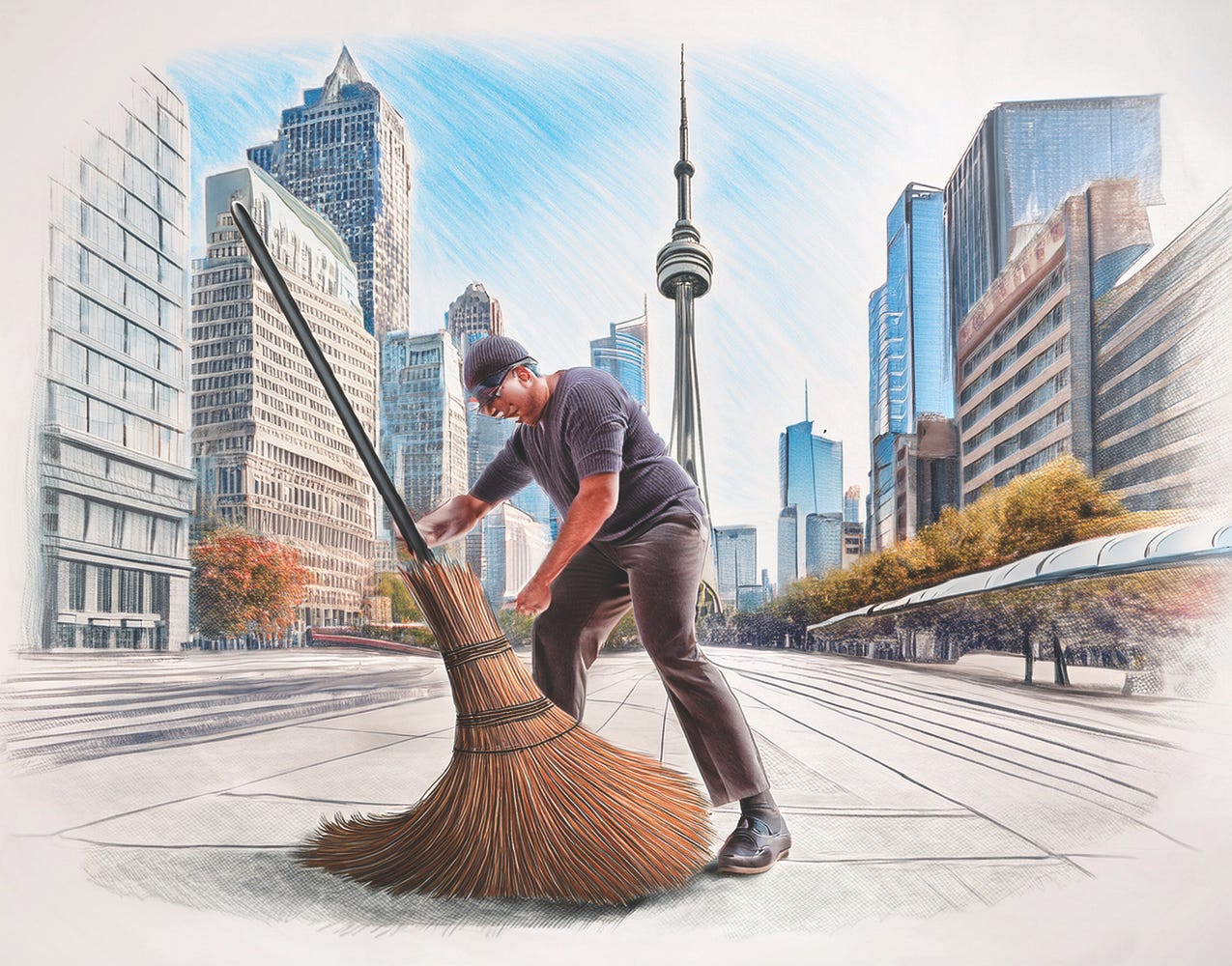
Today, in the days before the 2026 World Cup, the problem of homelessness is not solved. At global events, the backdrop must be right. Those who don’t fit the picture are removed from the frame — quietly, efficiently, before the cameras arrive. Like cars on a used-car lot before the sale, the rust isn’t repaired — it’s painted over. FIFA demands a picture, and the picture tolerates no visible poverty. And so those who don’t suit the cityscape are cleared from the frame. It almost plays like a badly told joke: Toronto spends millions making people invisible who could have a roof over their heads again for a fraction of that money. The cleanest city is not the one without homeless people — it’s the one that stops producing them. A city that understands: sometimes an envelope of cash and a little trust is smarter than any apparatus.
Rutger Bregman put it more briefly:
“Poverty isn’t a lack of character. It’s a lack of cash.”