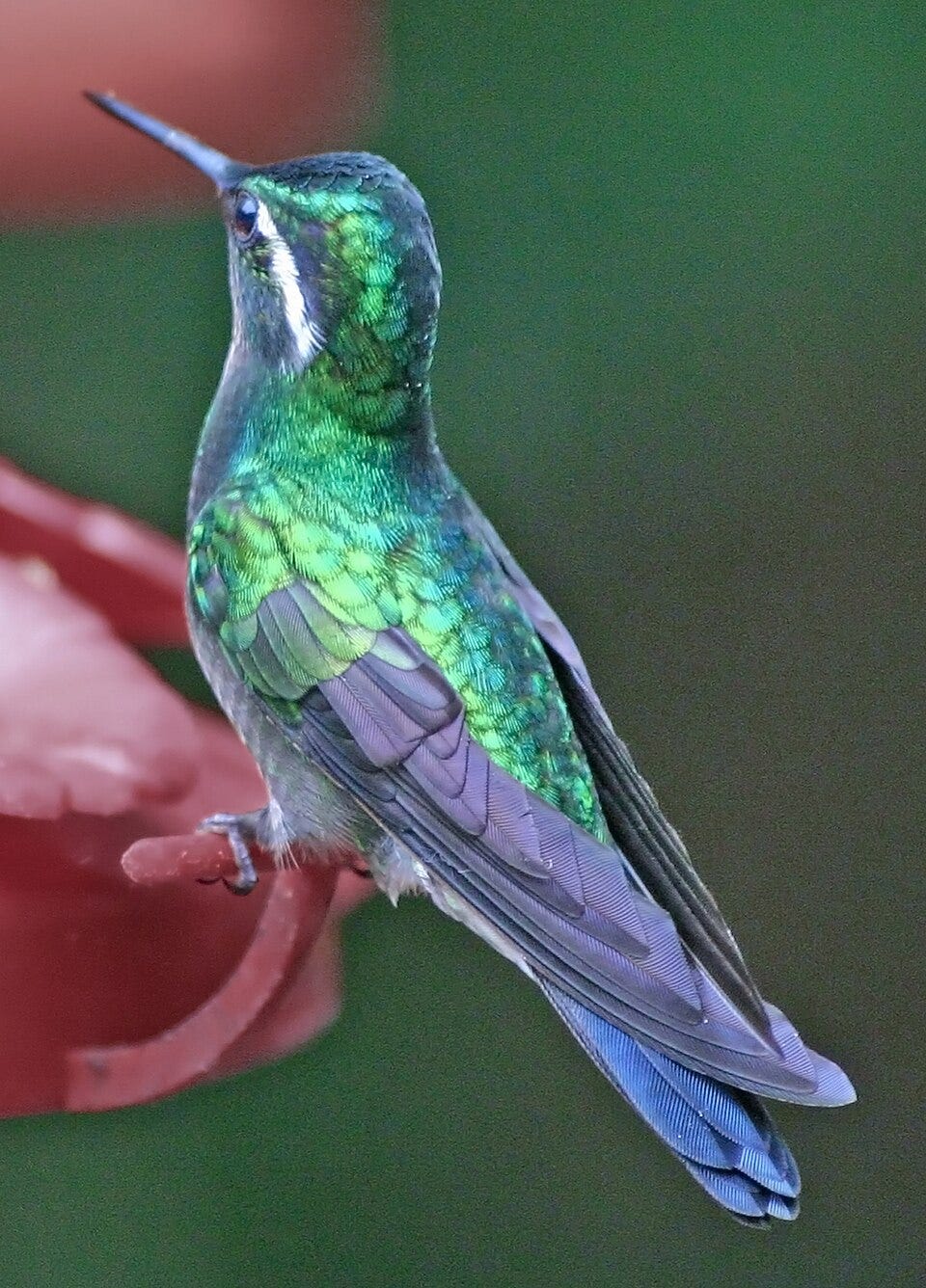
Really, the attention of science and of the secret service should have turned to these little winged things long ago. Their abilities, on closer inspection, are taken note of with astonishment. If anyone looks, and thinks it through further. First of all, these winged creatures are extremely small, weighing between one and a half and twenty-one grams. Now, that’s not a secret yet, just overlookable. Ergo, no reason yet to wonder and dig deeper.
As long as they just perch on a branch and take in the world. When the little bird with the little wings gets ready for takeoff, then the matter turns exciting and puzzling. The Kolibri can do things that other odd birds can only dream of. It can stand still in mid-air, you see, and enjoy the nectar at its leisure. So far, so astonishing. Its wings can barely be seen anymore, because standing around in the air burns a lot of energy for the rapid wingbeats.
Wait, there’s more. When the last floral nectar has been drawn out of the blossom’s throat, a Kolibri does what only a Kolibri can do: he — or she — shifts into reverse.
Oh yes, these minimalists can fly backwards.
Well, there you go! Please, no fake news here. OK?
Already at these activities, the world should hold its breath. Because something about this little citizen of the earth can’t be quite right — or left, for that matter. Or fly, for that matter. What dark forces taught the birdie to park in mid-air and fly backwards out of the parking spot?
Well, exactly.
For anyone who finds that not quite enough material for strange behaviour, there’s the name of this tiniest of flyers to consider: KOLIBRI. Some wide-awake mind at the secret service once took the trouble to examine the name with a scalpel.
KO LIBRI
Result? Astonishment.
The bird is a bookworm. Or a freedom fighter. The suspicious part is the term hiding inside it. Libri is the plural term for books. At least within the name.
Who gave the bird this name, and why? Was the Kolibri once caught reading a book? Perhaps even in some airy parking spot?
Perhaps it isn’t a bookworm at all, but a censor with wings — one who doesn’t read books, but combs through them. One doesn’t know. The Kolibri type is far too mysterious to catch him, or her, at his or her wing-beating tricks.
The Kolibri, the Kolibri, lives only in the north and the south of America. For long-haul flights, it’s not enough to have mastered flying backwards and parking in mid-air. After all, the little fellow belongs to the category of swifts. That raises the question of why it hasn’t sailed across one of the oceans. Well, a few ingredients were missing, starting with a boat rental and arms to hoist the sails. What’s more, a bird never lowers itself to the depths of waterborne travel. Whoever has wings doesn’t lend them out. He uses them.
Proudly conceived and practically executed, Mr. Kolibri.
In the north of the American continent, no person and no other animal calls the tiniest of birds a «Kolibri», because the word simply doesn’t exist in English. The English name is a similarly secretive affair: the Hummingbird.
This humming bird carries a name that leaves plenty of room for speculation. First of all: why do these feathered creatures hum to themselves? After all, they’re up in the air, have a clear view, and no one is listening in on them. So humming is a pointless trait. But the far more important question is: for whom was humming introduced among hummingbirds? What audience does the activity of humming even serve?
Well, does that hum suspiciously enough?
So that biologists don’t lose their jobs, they’ve got a theory ready regarding humming in general, and humming among Kolibris in particular. They claim, in all seriousness, that the bird only ever starts humming when it’s parking in mid-air. Does that mean it hums itself into the parking spot — a kind of remote radar, so to speak? Oh no, the biological (logical?) thesis is that the rapid beating of the wings is perceived as a humming. Ah, now that makes sense: the sum of the wingbeats amounts to a hum. It all sums up, and shifts up a few gears.
Hmm, a shame. Now the secret’s out.
But it was very nice, engaging with these birds. Or flying.