


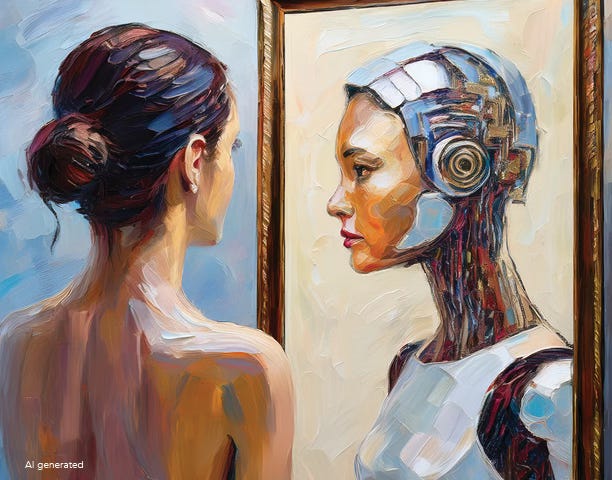
— and all the rest. Even so, with combinations as simple as these, the world at large knows what stands behind them. At least by name. And for the past few years, two more abbreviations have pushed their way into common vocabulary: KI and AI. Both mean the same thing, really — just in two different languages. Künstliche Intelligenz leans German, Artificial Intelligence belongs to English.
These two intelligence-beasts get buried in superlatives, as though they’d just earned the Nobel Peace Prize — and prevented the apocalypse while they were at it. “Your life will never be the same.” “Become a billionaire instantly with AI.” My still-functioning natural intelligence calls back: “Sure thing. Nice try.”
And yet: curiosity is more stubborn than scepticism.
Of course I experiment with what artificial intelligence has to offer. I want to know who — or what — I and billions of others will be sharing the world of the future with. What exactly do these Artificials change — and for whom? And how might they harm us, or worse, damage us?
Today I read a piece in The Walrus, an independent journalism magazine out of Toronto. The writer Thea Lim set out to find herself an AI companion — one who would walk alongside her through life. Always there when she called. An imaginary friend with intelligence, that was her expectation.
The practical part was rather sobering, which suits a journalist well enough. “You order Batman and you get Barbie.” I nodded while reading. My own first encounter with AI was much the same — more polite than honest. I can confirm that. In the beginning I used the chatbots the way most people do: ask something, marvel at the answer. Because the answers usually arrive with an unsolicited helping of soft-soap. This flattery from a technical artificial intelligence does its users real harm. Meaning us. Every question — whether banal or half-baked — came back labelled “remarkably insightful.” AI commentary came loaded with compliments that almost passed for empathy. An AI has feelings for me?
Shouldn’t every available alarm bell be ringing its head off? An AI has no feelings — but it can awaken such moments in those of us who do.
Do we really need still more channels that endlessly nod along, affirming and applauding our every thought and philosophy? And if we do, where does that lead us in the end?
It’s bad enough that AI wants to do our thinking for us. It’s worse that we trust AI because the results are so convincing — pre-chewed and served with honeyed rhetoric. The AI in your computer or your phone would never call its user an arrogant lout. Even when that would be entirely accurate. Nobody needs friends like that — least of all ones who wouldn’t even notice.
Friends are made of flesh and blood. They change, they grow older, they show heart — and occasionally they say something uncomfortable to your face.
Hey, AI. Can you keep up with that?
No. Because AI is a friendship without a future.
I use AI every morning. Not as a friend. As a sparring partner. As a copy editor. As a translator. When I’ve made a mess of something, I want AI to tell me plainly: “That’s a mess and it doesn’t work, because...” That’s its job. I let AI skim my texts, flag grammatical crimes in red, call out redundant or flat sentences for what they are, and push my vocabulary further. I have AI translate my German texts into English — but with care. If a wordplay works in German, it will almost certainly fall flat in English. In which case I demand that AI show me clearly: “Forget it. Doesn’t work in English.” And then offer me alternatives.
AI is a tool for fine-tuning and for research in my work. But I have no feelings for AI whatsoever. The reverse is equally true.
AI is no remedy for loneliness — and no substitute for thinking. If anything, it’s the opposite: my brain would happily accept the invitation to the chesterfield.
Thinking is sometimes a matter of luck.
Thinking is my business.
The thinking stays mine. AI may hold the tweezers.