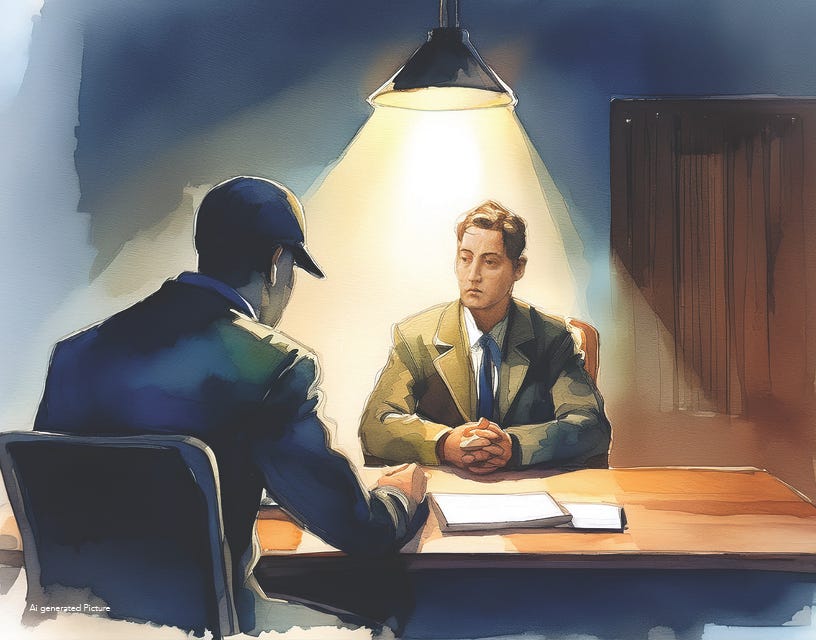
“What is the motive?”
Rarely does anyone ask whether a motive was even involved in the act, the decision, or the deed. The moment someone moves and does something, the question of motive follows automatically.
“The perpetrator’s motive is unclear.” Well, probably less so for the perpetrator or perpetrators themselves, since they did let themselves get carried away into the act. Most perpetrators are fairly certainly highly motivated to surrender to that being-carried-away.
Sometimes I ask myself the next morning: “What on earth were you thinking?” Reflexively, I blame one of the millions of motives. After all, I didn’t come up with this on my own. There was at least a piece of creativity, a pinch of foolishness, and a generous helping of motivation involved. Otherwise I’d have left the whole thing alone.
Is the motive itself that powerful? I think so. A motive alone doesn’t make an act, doesn’t make a work of art, doesn’t make an achievement in itself. A motive has to crystallise — that is, it first has to form itself out of the tangle of reasons, questions, arguments, and contradictions. In the end, before the actual act, there should be a sentence that could be spray-painted on the wall as a motive.
The real motive often likes to hide inside a single word. What am I to make of a leitmotif — or a *leid*motif? Is it perhaps the motive itself that guides the free person? Hardly. That applies more to the motive for a crime. At some point someone arrived at a conclusion and with it at the motive to carry out an illegal act. In the artistic realm the motive becomes clearer. It usually stands or lies at the centre of the artistic motivation as an image-motive. Sometimes the motive sounds out as the beginning of a melody. An example? Well, old Beethoven showed it mathematically. His Fifth opens with four notes. And yet the equation worked out.
Ah, now I see the driving force — as an image-motive, so to speak. Inside the word “motive” lurks “movere” as a root. I move because I am motivated. The motive is the motor of events.
Well, there we go. Told you.
What burns me with curiosity is what moves you when a motive makes itself known.
What, demotivated?
Now what’s that supposed to mean? Oh yes, I know it far too well. Anyone who wrestles with ideas, visions, and then plans often gets the club of demotivation swung round their ears as well.
Who came up with that idea? Why should I demotivate anyone? Fair enough, stopping someone on their way to an actually planned crime — demotivating them, in other words — that makes sense.
But demotivating people who may well be motivated, through sheer smartassery? Why?
In my storm-and-stress years, writing was my motivation. Engaging with the world and its stories, diving deep into a story idea and then writing it — that was and remains sweaty bliss. Of course I saw myself as an author who writes a book every year and can live from it.
Then the demotivation story came wheezing around the corner. “Hardly anyone can make a living from writing, Christian. Learn something sensible.”
No, I never stopped writing. Why would I? The motive of telling stories with twenty-six letters is too strong.
Yes, it took time before I could live from writing.
The motive doesn’t care how long something takes, because motivation is not bound to time. It is bound to the movement of my ten fingers and a bit of brain grease.
Listen. Watch. Speak.
I listen in. I look on. And I write along.