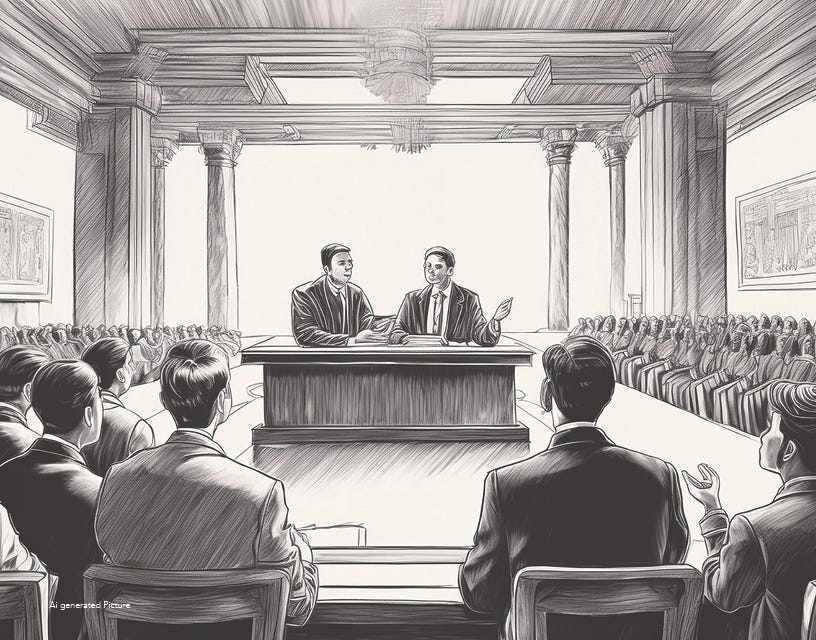
Usually lush formulas parade across the blackboard. But this time, the lushness had vanished along with the formulas.
Instead, Randy Boyagoda stood before students who are usually more interested in technical and scientific excursions. But in the nighttime series «Night Owls», it’s only about listening — while a philosopher talks about things that won’t polish a single student’s resumé.
«So why are you here? You’re here because you’ve decided to live as though ideas mattered.» said Professor Boyagoda, with a wink.
Future engineers and statisticians, who otherwise juggle formulas, just sit there for three hours and listen. At least for one evening. A full three hours, over a hundred students sat and stood in the lecture hall this past Thursday.
And what did the curious get to hear?
Philosophy concerns itself with ideas that don’t yet need a purpose. Thoughts and visions, in other words, that need not be useful — not yet, anyway. Ideas that generate no profit, advance no technology, and need no cost-benefit calculation. They’re ideas that can simply be discussed. Thoughts that hang in the air, still in a first rough draft.
And in the Toronto lecture hall?
Fundamental things were floating about. And how: things got right down to the heart of the matter. For instance, the comparison between cooperative and competitive capitalism lay on the dissection table.
Or whether modern dentistry counts — or could count — as a triumph of prices and markets.
And of course the newly flared-up idea of genuine socialism, or what U.S. Senator Bernie Sanders stands for.
«That’s just Canada.» said one of the professors — and that’s exactly where the real question hangs itself: what is Canada’s education policy actually willing to afford itself?
Canada is also a policy for education.
But what does the makeup of what’s on offer actually look like?
Schools are preparation for the working life that follows. Fundamentally. So those STEM subjects — math, computer science, science, and technology. In other words, the subjects that will offer a graduate a job.
Or might.
Understandable enough, so far.
Where does that leave the offering for the arts and humanities in schools?
When funds for the school system get allotted and written down, the humanities turn up with the lightest weighting — that is, the smallest allocation.
When it comes to funding, they’re the tail light of the pack. That’s not just about how they’re valued, but also about lower costs. Studying philosophy needs neither a lab nor other technical expenses.
Cheaper to produce, same price at sale. That, too, is a kind of economics lesson.
That’s exactly why I got stuck when I read about these night owls, who started a philosophy series in the middle of this very system — a philosophy series at the University of Toronto. People, it turns out, aren’t only interested in economics or technology. They want to know and explore how to handle thinking itself. And life itself. Or as the head of the Philosophy Department at U of T Scarborough puts it: «Philosophy teaches you how to really think. Paired with a technical subject, that’s a kind of power combination.»
Numbers are important. Numbers are clear. But between the rows of numbers lies the creative, the free thought, the visions. Without these «useless» subjects like philosophy and the arts, thinking tends to become one-sided and conformist.
Hey, is this my moment again to beat the drum for art and philosophy?
Oh yes.