The real barriers were of a different kind.
In the last hours before the deadline for the trade talks, new demands from the US negotiators landed on the table. And these really had teeth, because they read like an extortion list, not a trade offer. And Prime Minister Mark Carney broke off the negotiations and called his negotiating team back to Ottawa.
Elbows are up again.
What really happened that made the Canadian prime minister decide on this drastic exit?
The US version: Trade Representative Jameson Greer accuses Canada of simply tossing agreed-upon terms overboard.
The Canadian version sounds different. The US threw additional conditions with restrictions for Canada onto the negotiating table.
And PM Mark Carney’s line, “No deal is better than a bad deal,” was also on the table. What on earth were the US negotiators demanding of Canada?
Just a few small things, they said.
Canada should not be allowed to sign trade agreements with countries other than the US. Mark Carney has concluded over twenty new trade and security partnerships with other nations over the past year.
Canada should make compromises on the protection of the French language and its culture. Compromises regarding Québec’s sovereignty and Francophone identity? Non, merci.
Anything else?
Oh yes, Canada should be turned into the 51st state of the US.
And that’s why Prime Minister Carney broke off the negotiations?
Yes. And with that, the US and Canada are officially in a trade war.
The current American president threatened, a month ago, 50 % tariffs on most Canadian goods. That’s a double dose of punishment — for Canadian suppliers on one hand, and American consumers on the other.
These new tariffs violate the CUSMA agreement, negotiated during the first term of the then-45th US president. A trade agreement between Canada, the US, and Mexico.
On July 1st, the US declined to extend it — without further explanation. This treaty runs until the end of 2036, but can be terminated by any of the three countries with six months’ notice. With the new 50 % tariff threat, the US is violating the very protective provisions of this treaty.
This game of punitive tariffs against Canada — and the rest of the world — has been running for quite some time now. Canada has responded to sometimes dubious-sounding justifications for the tariffs.
There were things like increased border security due to fentanyl smuggling from Canada into the US.
Canada’s planned digital tax on US tech giants was withdrawn, along with many other concessions.
It got them little: sometimes a small reprieve, sometimes nothing at all — depending on the mood in the White House.
Ever since the US president imposed these tariffs on Canada, it’s been the Canadian public in particular that’s gotten active.
Canadians rarely get loud. This time, they did — and the numbers show it.
For example, a full 42% of Canadians have skipped travel to the US.
Meanwhile, travel within Canada rose by 5.1 million visits.
Imports of US alcohol into Canada dropped by a whopping 81%, and other US products labelled “Made in USA” are being carefully avoided by consumers made in Canada.
So what will Canada do now to counter the US’s 50 % tariffs?
Step by step, dollar by dollar, Canada will impose the same tariffs on US goods.
The provinces will continue to keep US alcohol off store shelves.
Mark Carney is halting all further trade talks under these current US demands.
And Canada will keep pushing for market access in the EU and Asia.
For many companies, the times ahead in Canada will bring not just a challenge, but layoffs and, in some cases, bankruptcies.
Canadian way of life will be more expensive for everyone.
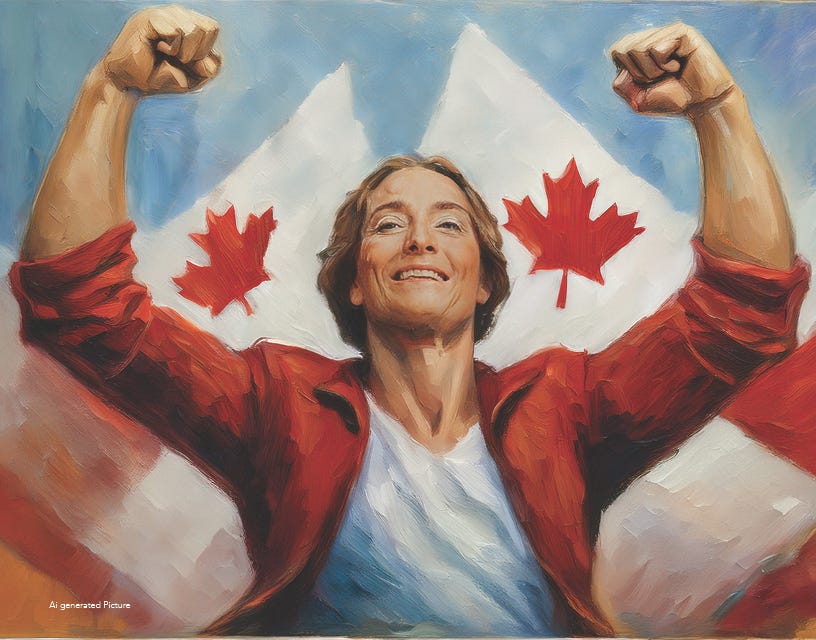
And yet: there’s a kind of pride you can feel in Canada — the pride of not caving to the bully.
Or as Wab Kinew, the premier of Manitoba, put it so well:
“You can’t make a good deal with a bad person.”