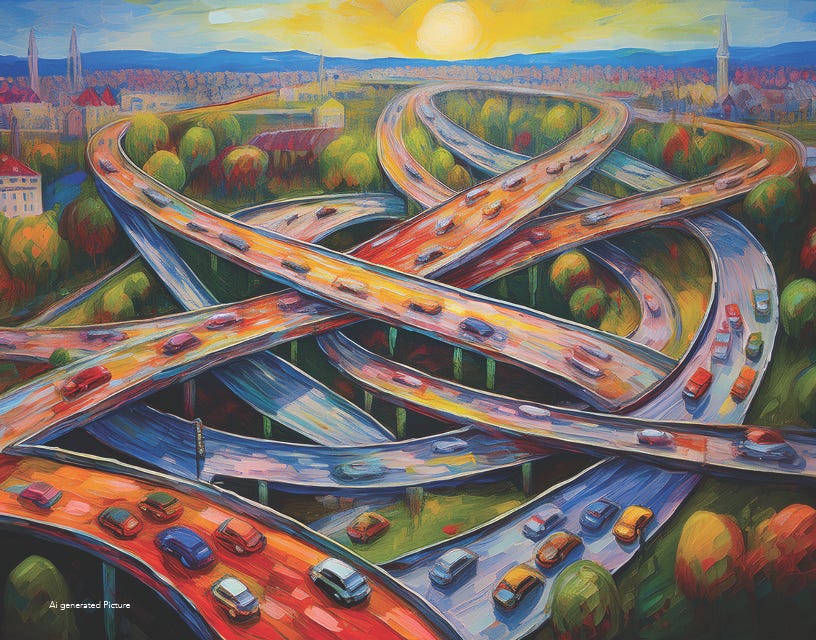
Somewhere, sometime, someone freed the circling thought. The escapee suddenly stood before a choice: which direction to run now. The invention was originally called “Per Speck Tiefe (depth).” The temptation, in other words, hung in a completely different direction and distance than had ever been possible in the circle. For ethical-rhetorical reasons the term was later straightened — er, streamlined — into “Perspective.”
The principle of perspective, upon reflection, turns out to be relatively simple. Change your position and keep your eyes open. Sitting at the table? Then get up and stand on it. And, how does the view look now? When I tried gnawing my teeth once again on some stubbornly stony problem, I would lie down under the table for a change and look at the matter from below.
Ah, so that’s all it takes — to see any given thing with the same eyes but a different way of seeing?
Yes.
I like perspectives. Mostly.
Sometimes they’re annoying too, when a plausible and already-welcomed idea, with a mere change of position, brings a whole pile of problems to the table. That’s irritating and a little disappointing. The enthusiasm for the idea melts away.
Well, that can hardly be the fault of the perspective itself. Quite the opposite. After all, it leads to the famous line: “I never looked at it that way before.”
There you go.
Perspective creates more view and more way than was ever planned for.
No, perspective is not a solution. At most it makes a problem — and sometimes also a solution — visible. A house of cards looks fairly stable from the front.
Perspective simply says: “Have a look at it from the side.”
Good old perspective has another side too, one I consider rather positive (once I changed my perspective on it). When it goes into action, when it changes the view, it leaves little room for quick judgments. And that’s a nice side effect when dealing with other people. Black-and-white thinking is far too dull and one-sided for perspective’s taste. It likes the colourful, the change, the slightly different look at a thing.
Or several things.
What’s more, this kind of playfulness is a satisfying training program for the mind. The synapses, I suspect, like it when they’re not stuck in the boring “all clear” mode but constantly confronted with other little games.
Marketing folks and inventors know this well. I remember the presentation from my training as a copywriter. The professor giving the talk said: “On the idea highway there’s heavy traffic. One of the idea-drivers sees a small exit and takes it. After a while the same driver comes back onto the highway with a completely new idea.”
That story still haunts my head whenever I’m dealing with a “truly great” idea.
Then I climb onto the table, or lie down underneath it, and play idea highway.