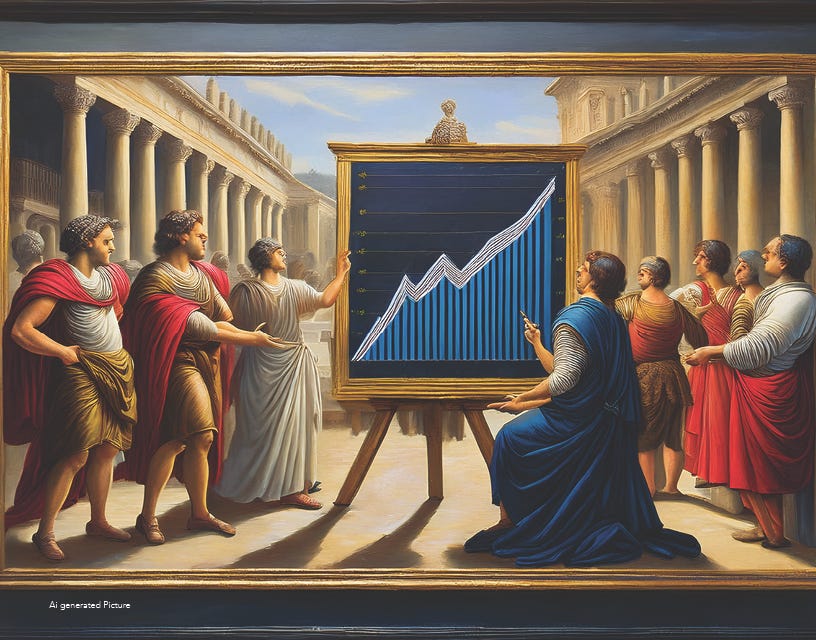
The old Romans weren’t necessarily rich, but they did have one. The Roman Empire “invented” the word “proficere,” and it was thoroughly steeped in the still quite lively Latin of the day. This Roman term was outfitted with positive qualities. Back then. Proficere meant getting ahead and being useful. And, of course, making progress along the way. Step by step. Well, the Romans and their empire showed the world what they actually meant by proficere.
Then the Old French showed up on the scene. They’re called that because, like the Romans of the day, most of these people are no longer alive. As always, the French had to bend everything into their own language. So they cut proficere down and made a trim, catchy word out of it: profit. Lower-case in French, it simply meant gain and benefit. Et voilà.
And what did the Middle High Germans do with it, when they were talking things over with the Middle Dutch?
Well, not really much. Since the Middle High Germans already didn’t much care for talking to the French, they turned to the Middle Dutch instead. At least they had a language on offer that carried, in some rudimentary way, a few German-sounding noises in its luggage. So they imported the word profit from Amsterdam, not from Paris.
A similar story played out in the 1970s, when Germans imported certain substances from the Netherlands. These, too, most certainly had something to do with profit and pleasure.
But the old question still hangs in the air: what was the term doing before it showed up as a unit in the history of language, back when it wandered through rhetoric as Pro and Fit, separately?
With Pro, one usually expects either something approving, and if not, then professionalism is meant. And profession stands for the job, or the calling, to do something useful. And thereby to put food on the table, and a house around the table. In principle, a simple story.
Whoever carries “professional” as an attribute is regarded as a member of the experts. Which, in the real world, also brings respect. Botching is a discipline too, but it has rarely achieved a long-term future.
Fit? Back then, before the Romans, being fit wasn’t an industry, and certainly not a topic. People wandered about the countryside. Partly for lack of their own land and any houses to speak of. Back then people were hunters and gatherers, but houses weren’t part of the package yet. Housing hadn’t been invented yet.
Ergo, fit wasn’t a topic, but a daily routine. Whoever wanders a lot, hunts, and sometimes flees, becomes fit automatically. Or gets eaten.
Is this whole thing starting to make sense, how the two words found each other attractive and joined together? I think so.
Pro spots Fit on the horizon and thinks: well, will you look at that. What an appearance, entirely without fat or padding. What a fine appearance, entirely without fat or padding. A well-trained short word with a powerful presence. What does Fit think, catching sight of Pro? Well, will you look at that. What a fellow, always getting ahead and bringing home the food. That one, I’m keeping.
And lo and behold, profit had a golden future ahead of it in the history of humankind. All Pro, all Fit?
In principle: yes. All professional and robustly fit, to meet the world’s difficulties and act.
But then either the Romans or the Greeks came around the corner and tossed a new term onto the rhetoric market: greed.
Sorry.