


In physics or geometry, hardly a single fibre of my body was awake. Too much data. Too much that made no sense. And too little that was exciting.
Could it be that scientific information is, deep down, always boring? Or is it just being flung at the audience in some brittle, joyless way? A few years back I came across a piece with the promising title “The Storytelling of Science.” Storytelling in science is not an impossibility. No — it’s one of the most fascinating ways to communicate science with excitement, humour, and above all, clarity. That much was clear whenever Lawrence Krauss, Richard Dawkins, Neil deGrasse Tyson, or Bill Nye told their stories — none of them boring.
Well then, storytelling works even on dry subjects.
Kit Lister is a 28-year-old Montrealer who shuttles between social media coordination for climate events and a documentary about Toronto’s bike lanes. Pretty sure he does the shuttling by bike.
“Oh no, not more climate doom and gloom?”
For Kit Lister, that’s not a dismissal — it’s the whole motivation. The young man marries scientific findings with stories — and the marriage holds, as his audience shows. Today marks the start of Climate Weeks Toronto/Montreal, running until September 13. So what does Kit Lister want to achieve with Climate Week?
Kit wants to get people excited about the many possibilities around climate change. But above all, he wants his stories to lead to concrete action: get on a bike, sign a petition, sweep up the neighbour. Most citizens worry about climate change and want action taken. That’s exactly what Climate Weeks aims to offer: connection, knowledge, and the hope that comes from acting together.
But that’s not all. Kit Lister has also produced a full-length documentary about Toronto’s bike lanes: “Cycling Toward a Cooler Toronto.” He wanted to know what effect bike lanes actually have on Toronto’s traffic, health, economy, climate, and future.
Toronto’s traffic suffers from the worst congestion in the world. Gridlock is the norm, not the exception. Sitting in traffic isn’t just wasted time — it seriously harms your health. Those ultrafine particles know no manners: they push their way into the bloodstream as if it were an open door. They weaken the heart, raise the rate of dementia, and increase the risk of brain tumours and other cancers. And the irony to top it off: more road space for cars doesn’t solve congestion. It creates more congestion, not less. When alternatives like protected, connected bike lanes are on offer, many people would rather hop on a bike, because it saves them time and money on their commute.
Why did Kit Lister make the film?
He wants to tell stories for an overwhelmed but engaged majority. He hopes they’ll get behind some of the many solutions for protecting people from climate change. The film shows how much better life can be when we roll out measures like bike lanes on a large scale. Protected bike lanes are proven technology that makes life more affordable, cleans the air, improves health, eases the commute, fights climate change, and makes life more joyful. But with one or two cyclists, it’s just a drop on a stone that’s far too hot. Good infrastructure creates the critical mass needed for that. Activist groups like Cycle Toronto are working hard on it.
And good storytelling can do all that?
Oh yes. People want to be motivated, not depressed. The majority isn’t sluggish because they’re not interested in the topic. They want to know what they can do in their everyday lives. Lots of small actions, in the end, add up to the big impact.
What’s doable? And what can I do? — when questions like these get answered by Kit Lister and other resourceful storytellers.
Hope stretches out its arms and says: “Count me in!”
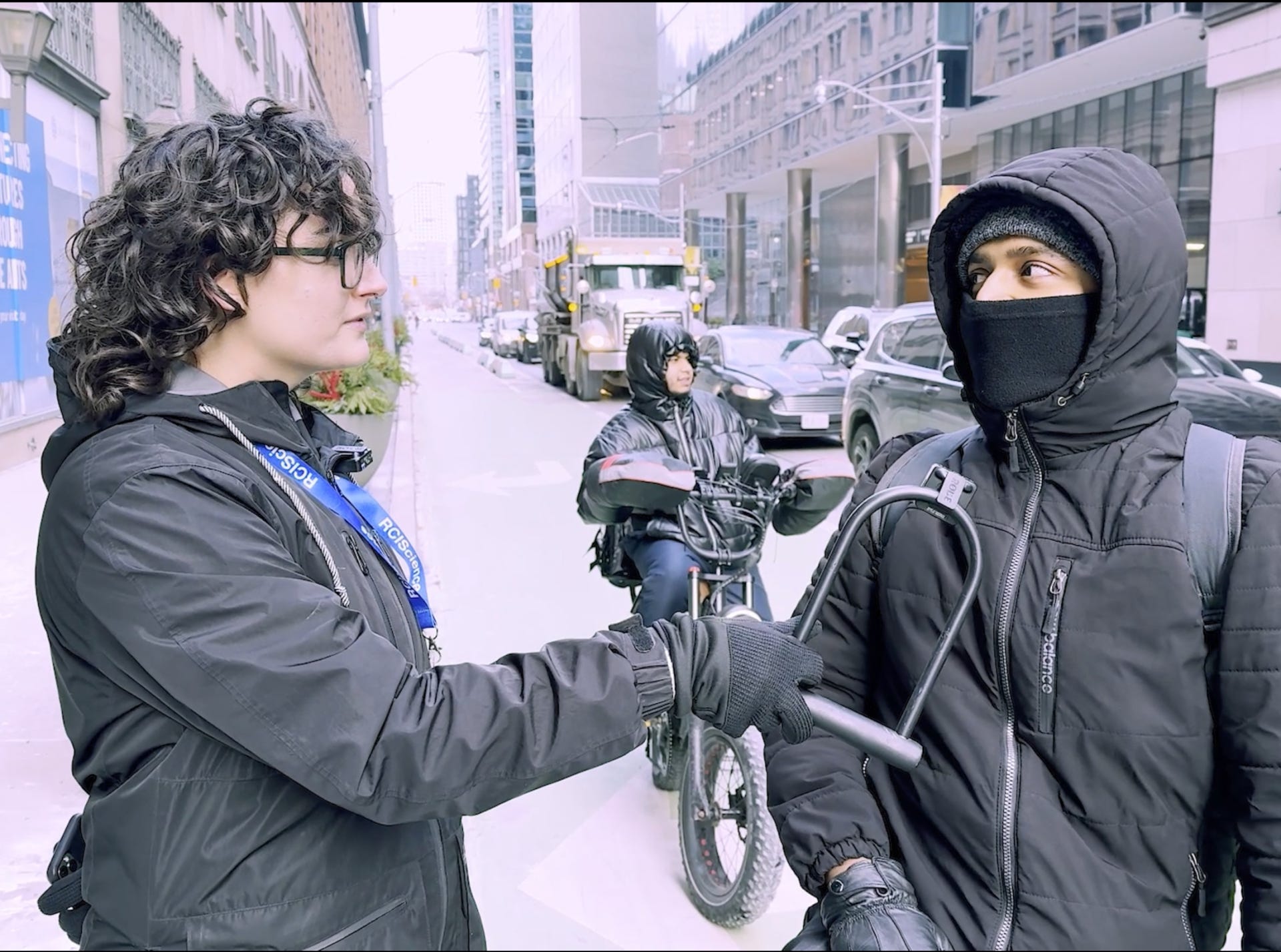
Kit Lister interviews a Torontonian for their documentary. Photo: Alex Nye.