Wait, are these the people who keep the place — the lobby — running, who clean it and keep everything tidy? Not exactly. These people are more in charge of influence. They operate rhetorically and financially in the political arena or within business associations. Well, look at that. How nice, how these experts take care of the neglected guild of politicians and business magnates.
Which lobby do these busy bees work for? Oh, the field is wide: alcohol, labour, nuclear, banks, energy, weapons — a matching necktie for every conflict of interest. And what exactly do they do to help these sectors?
The job description shows just how demanding and time-consuming the daily work of lobbyists is. The basic task of the lobby team is to influence decisions made by politics and administration entirely in the interest of their employers. This is meant to keep relations between various interested parties running smoothly.
Ah, I see. That sounds good and efficient.
The lobbyist as such is kept fully busy watching for possible new bills or consultations. They loiter in the hallways of parliaments or show up on the golf course, cultivating direct and useful relationships. They are, so to speak, the nursing staff for political actors and their willingness to decide.
Nursing staff indeed. Except the patient rarely knows he’s being treated.
The second chapter of the lobbying handbook is devoted to information. Lobbyists move in formation to deliver expert knowledge, numbers, and argumentation kits to parliamentarians and other officials. Some specimens among the busiest lobbyists go so far as to draft entire bills, ready to go. This saves the guild of politicians a good deal of tedious work.
Now that really is nice, and ever so helpful.
Point three of the little lobby handbook is relationships — the nurturing and tending of the useful network. Since lobbyists generally come across as tidy and likeable, they have direct access to holders of power and influence. And there, the same language is spoken — just with different goals. At first, anyway.
Paragraph number four of the advanced lobby handbook is the coalition-building kit. No, this has nothing to do with the Australian bear. Or only at the margins. Because those sought for coalitions are meant to become allies. Often these new allies are rather unusual, but useful.
And then the crowning discipline number five of the lobby manual: public pressure. No, not the pressure of the manual — pressure on the public. The toolbox has valuable things on offer to carry out this important work of influence. Campaigns, for example, help spread lobby-tinted arguments. And naturally, media work helps along the way. Selfless? No idea. And finally, the so-called grassroots of the public get mobilized. That is, party members, sympathizers, and those affected by the bills receive simple, emotional messages that flip the switch into active mode.
OK. The mockery ends here.
And who exactly commissions these lobbyists? In Canada, amusingly enough, it’s the employees of organizations themselves who carry out a large share of the lobby work. Two years ago, there were nearly nine thousand people who had been engaged at least once as a consultant or in-house lobbyist. The Lobbying Act defines what counts as lobbying. But even here, the real size of the lobbying community is fairly unknown.
In Switzerland, there’s a third party sitting right in the chamber. In the militia parliament, council members themselves hold association or administrative mandates. But the truly Swiss system of active lobbying is the so-called Götti badges. Each council member may hand out two such access badges. The 26 cantons weren’t about to miss out on that, and since 2012 they too may send a representative of their interests to Bern.
Is that proper? Apparently so — nobody has ever handed back a Götti badge.
Now, the lobbyist as such isn’t the villain in the room. The idea behind it was that parliamentarians only possess general knowledge. To gain deeper insight into the issues or the wishes of various industries, lobbyists can help.
The practical side shows that access to parliamentarians is distributed unequally. Whoever has money, lots of money, and staff at their disposal is present daily in the goings-on of parliament. Those affected by future laws, however, are hardly present at all, neither through representatives nor through lobbyists.
I think, fundamentally, the idea of lobbying as a civic right is understandable. But only as long as it happens in daylight, that is, stays public.
But in the lobby of world affairs, it’s not only influence through arguments that’s common practice. Because alongside arguments, something more tangible flows too: donations, mandates, gifts, trips.
Allow me a brief comparison here between Canada and Switzerland. Oh yes, partly just for fun.
In Canada, only individuals are allowed to donate. Not companies or unions.
In Switzerland, companies and associations may also donate freely. Even upwards of 100,000 francs.
There are, however, upper limits to this donating enthusiasm. Canadian parties may collect $1,500 per year, per party.
Swiss parties know no ceiling and no restrictions on donations.
In Canada, a donor’s name and address are reported once a contribution crosses the threshold.
In Switzerland, by contrast, donations of 15,000 francs or more have been published by the Swiss Federal Audit Office since 2023.
Cash amounts over $20 are banned in Canada, and in Switzerland anonymous and foreign donations are banned.
There are further rules still, for lobbyists and those who want to become one. But in both Canada and Switzerland, there’s a lively distrust of too much concentration of power and influence.
The Swiss reflex: fewer bans, more light instead. Civic sense instead of bureaucracy. From this stance, Swiss freedom would be defensible, provided the threshold comes down and income from mandates becomes visible.
Canada’s ceiling fits its basic distrust of concentrated power.
Is that enough to curb direct influence on politicians? Hardly — transparency is no bouncer.
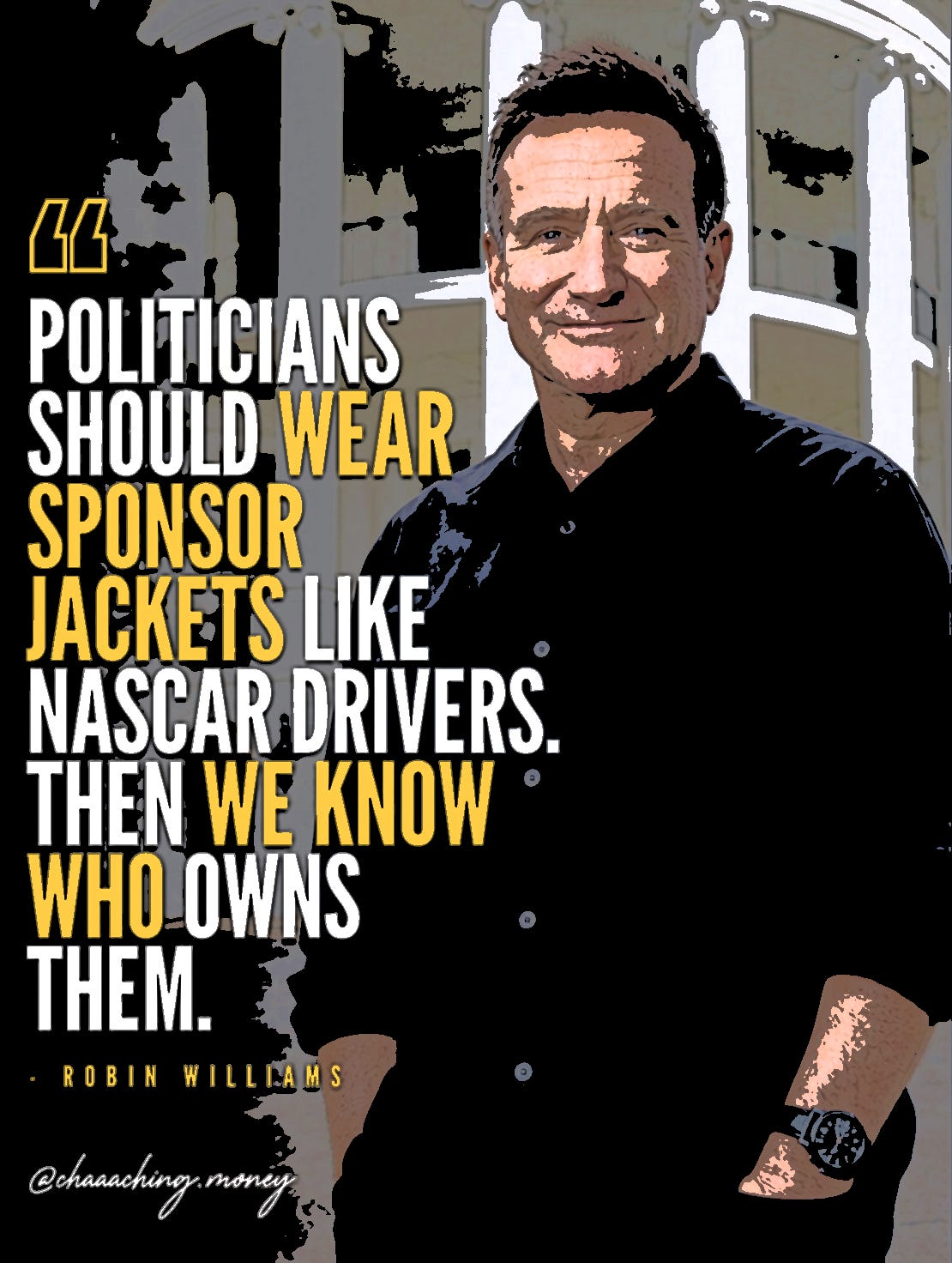
Or as Robin Williams put it:
“Politicians should have to wear sponsor jackets like NASCAR drivers, so voters could immediately see who owns them.”