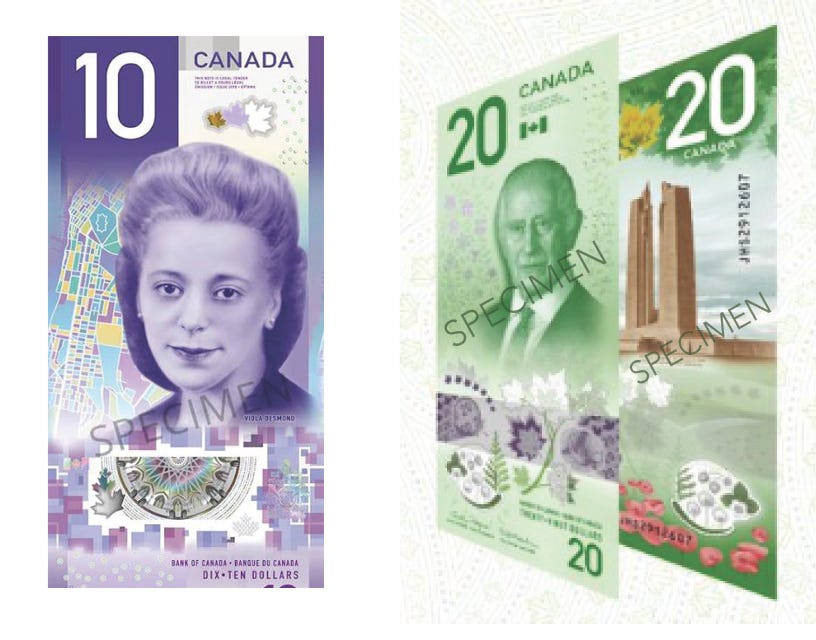
And honouring the new twenty with the first monarch change on a banknote in seventy years.
The twenty is Royal Vertical.
Because up until now, horizontal was the tried-and-true rule — Charles breaks it right away, with his very first note. Well, money always has two sides to offer. That’s true first of the history and second of the layout. On the front, the portrait of Charles III is framed by a carpet of flowers and leaves. King Charles amid the greenery is a nod to his lifelong commitment to the environment. The thirteen floral emblems represent Canada’s 13 provinces and territories.
Beside it, in a small round window, grow the culturally significant plants of Indigenous peoples. With wild strawberry, the giant tree of life (western red cedar), braided sweetgrass, and Arctic cotton grass, this represents the Bank’s Indigenous Advisory Circle — and stands for nourishment, gratitude, and healing. Background on the individual plants (from general knowledge, not from the Bank’s own source):
The wild strawberry is the “heart berry” to the Anishinaabe and Haudenosaunee, and as the first fruit of the year, it’s regarded as a symbol of reconciliation and new beginnings. On the West Coast, the cedar is the tree of life — canoes, houses, clothing, ceremony. Sweetgrass is braided like hair — “the hair of Mother Earth” — and is burned for smudging. Along with tobacco, sage, and cedar, sweetgrass is one of the four sacred medicines. And cotton grass stands for the North — Inuit used it as a wick in qulliq oil lamps, the sole source of light and warmth to make the igloo more bearable. Why the other two sacred medicines, tobacco and sage, are missing from the depiction, the Bank doesn’t say. Perhaps it’s the four directions — East, West, Prairie, and Arctic — that play the lead role here, not ceremonial completeness.
The back of the twenty-dollar note shows the Canadian National Vimy Memorial in France, meant to commemorate Canada’s military sacrifice. Vimy Ridge (April 1917) is considered the birth hour of Canadian national consciousness, when four Canadian divisions fought together for the first time. Walter Allward’s memorial was dedicated in 1936 on French soil and left to Canada in perpetuity. Vimy Ridge has been on the twenty since 2012, and stayed put while the Crown passed from mother to son.
So Vimy Ridge stayed standing. What’s new is only who stands guard on the front: Charles, the second vertical note after a pioneer. The first note in portrait format was the ten, with Viola Desmond pictured. The first vertical note was unveiled right on time for International Women’s Day, March 8, 2018, and sent into monetary orbit. This was not only Canada’s first vertical note, but the first with a Canadian woman gracing the Canadian dollar alongside the Queen. Viola Desmond, incidentally, was chosen by public vote. How so? Why?
Well, Viola Desmond was a businesswoman from Halifax, a beautician with her own beauty school and product line for Black women. On November 8, 1946, she was in New Glasgow, Nova Scotia, waiting for her car to be repaired. To sweeten the wait, she went to the Roseland Theatre — and sat down in the orchestra seats. The seats reserved exclusively for white patrons. Police dragged her out of the theatre and threw her in jail for the night. Viola was officially charged with tax evasion — over the one-cent difference between balcony and orchestra seating. This happened nine years before the unyielding passenger Rosa Parks. Viola died in New York in 1965 and was posthumously pardoned by Nova Scotia in 2010.
From the unconventional Viola Desmond to the royal Charles to the vertical note — two faces, one format. The pioneer of civil rights, and the king for the representation of the law.
Incidentally, Switzerland decided exactly ten years ago to likewise offer banky notes in vertical format. A small Helvetic revolution.
But let’s not get money-glorious now, ladies and gentlemen.