That would be quite embarrassing.
Oh right, the word “total” has something to do with total, too.
And the sum of numbers is also a total. But this time as a noun, because this is a serious business: the summing of money, revenues, statistics, and other number games.
So is the term “total” an accounting word, then?
Yes, certainly. But not only that, because the word — like so many other words — was lent out to other disciplines and schools of thought. Or handed over entirely, for good.
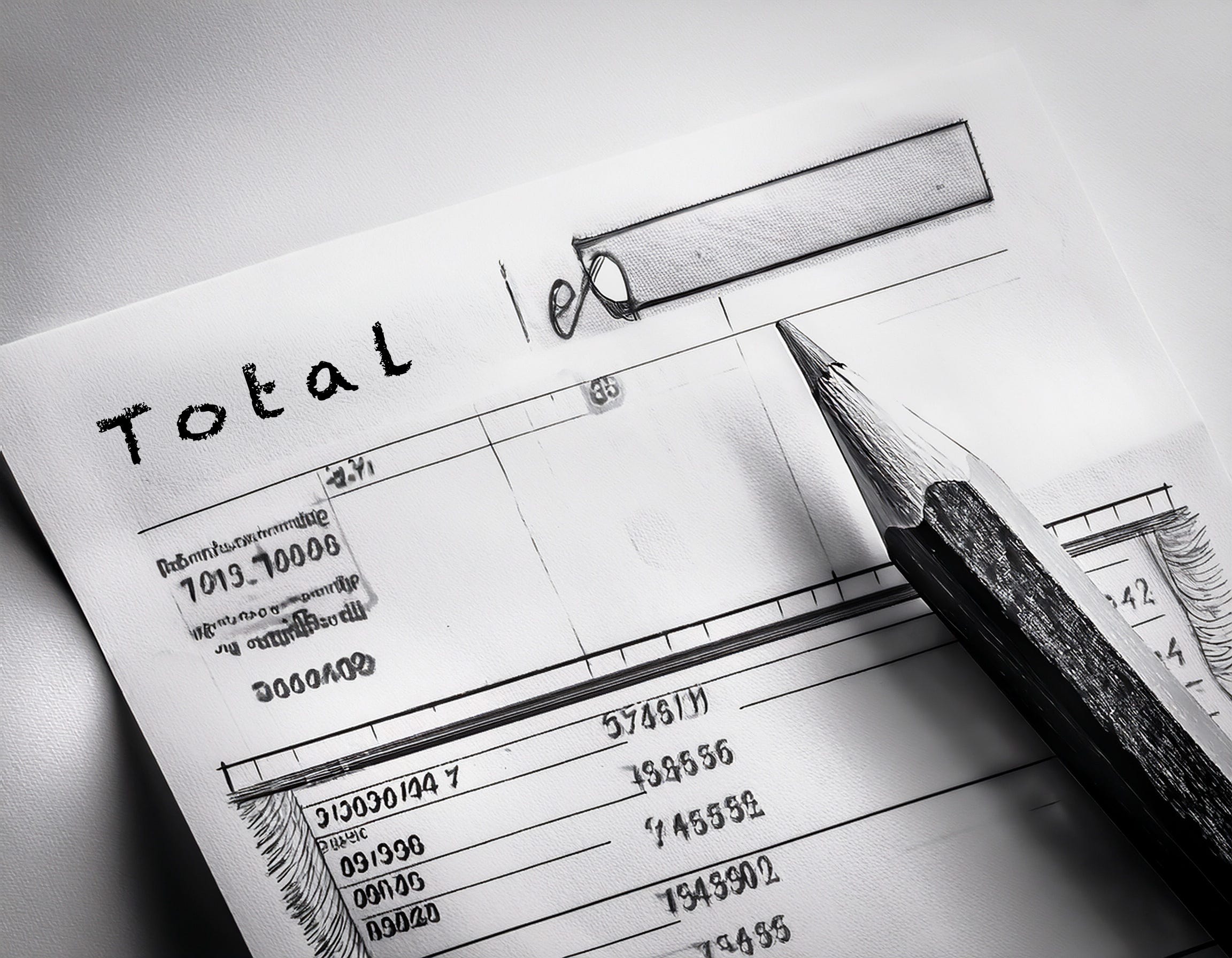
Total doesn’t hide under a bushel, but it usually sits below the line.
Because that’s where the sum of all things — or some things — gets given as a number.
The total.
The sum.
Power in the Total
In the 18th century there lived a man who knew his way around totality: Immanuel Kant. From that grew the battle term “totalitarian,” which had to serve as cover for the power-hungry and for dictators. “Do you want total war?” was one such dreadful sentence, one that already let the first part of the word ring through. Since we’re already on the subject of Latin, this story absolutely deserves a mention. In the 1920s, the liberal politician Giovanni Amendola suggested that the government under Mussolini wanted to erect a “sistema totalitario.” The regime didn’t take this as an attack but adopted it as a badge of honour — into its vocabulary, and into its practice.
Whole and Wholly
Language, as we all know, is a very lively thing. Unless it’s called Latin or Ancient Greek. A language expands its vocabulary with new terms and promotes others to the rhetoric graveyard. Young people especially are extremely keen to toss new terms onto the fairground of words. I still remember well back when youth-grown terms like “totally good,” “totally forgot,” or “totally hammered” were sprouting up. Total stood for the highest rung of the ladder. Nothing was perched any higher that could describe a state even more extreme. It was the total top position in the language hierarchy.
But as with all things used too often, they eventually wear thin and lose their total effect. The whole — that is, the total — in everyday speech became a hollowed-out term. Hardly anyone speaks in “totals” anymore, except people in the world of film. A “total” there has a quite different meaning than a rung on a ladder. There, the whole picture is simply meant to be shown.
Totally Perfect.
No, this isn’t some Doppler effect. These two words are neither related nor in-laws, although they pass themselves off as relatives. In reality, the two terms mean the exact opposite of each other.
Oh really?
Total leaves nothing outside. No gap, no edge, no outside. There is no outside, because total is a term for quantity. And quantities are contents within a sum. Quantities are contents that close themselves into a sum.
The word “perfect” has Latin parents named “perficere.” That means “to bring to an end” and “to complete.” Something is finished, and also turned out well.
What’s the point of this excursion into comparisons anyway? Hey, it’s half past five in the morning and I can understand the question, but not answer it.
But I’ll try anyway, after all this is a morning splinter.
The totalitarian system sees itself as the incarnation of perfection. After all, a kind of totality is established here, because nothing and no one stands outside the system. Or lives. So if nothing is outside anymore, there’s also no yardstick, no comparison left, against which a result could be measured. The total or totalitarian state isn’t perfect — it has simply abolished every possibility of comparison. How totally clever is that?
With “totally good,” the same thing is meant on a small scale: not “good measured against something,” but “good without comparison” — ergo without scrutiny.
Whoops, what a total muddle my little head has gone and made here? As a Swiss-Canadian, I have to call on my Swiss origins a little, so as not to totally lose the overview.
The Swiss citizen, as such, trusts sums — that is, totals — but not wholes. There, the Helvetic soul grows a bit suspicious. Just ask Gessler and his hat.
A sum can be recalculated. A whole you have to believe in.
The Swiss are used to every receipt ending with the word “Total.” So far, so arithmetical.
When “total” drifts into the political, the Swiss grow wary of the term. A small country like Switzerland affords itself four languages, which could be called the total of its official languages. It also affords itself many parties, so that “total” cannot find a sneaky path into politics. Switzerland affords itself no fewer than seven heads of state, for the very same reason: so that no single person can stiffen into a totalitarian system.
Switzerland: a country that trusts the total and mistrusts totality.
Total nice, eh?