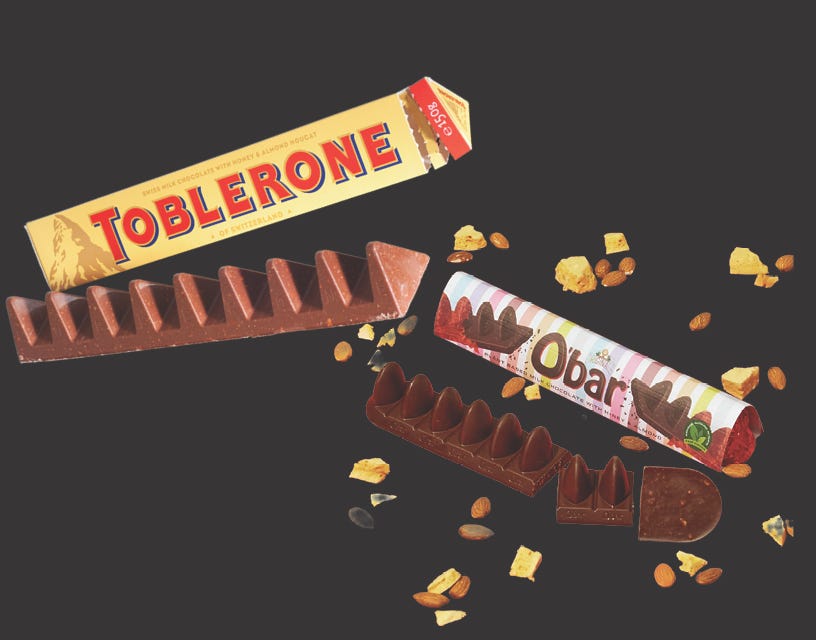
Toblerone hardly needs introducing to anyone anymore. After all, that row of peaks cast in chocolate fits the Swiss stereotype perfectly. Mountains, watches, and precision. It hardly gets more Swiss than that. Almost. Because the brand itself hasn’t been Swiss for a long time now. Because the Toblerone brand has nothing to do with Switzerland anymore. The US conglomerate Mondelēz has stripped the Swiss classic Toblerone, and part of the production, out of Switzerland. Three years ago, the company had to give up the shape that inspired Toblerone in the first place — the Matterhorn. The Matterhorn stays in Switzerland. Toblerone no longer does.
Toblerone is beloved. The conglomerate is not.
When Swiss people show up abroad, one of those enormous Toblerone bars is a popular gift. It’s bulky, nutty, and carries the full taste of chocolate-land Switzerland within it.
The mighty, sweet symbol of Swiss mountain and valley is known the world over.
And then along came teenager Catherine Dodd, out of the vegan corner of Walberton in Sussex, England, who founded her brand “Catherine’s O’bar!” So far, so sweet. The full-time mother of three kids had come under financial pressure, since a job was out of the question. The famous, infamous lightbulb moment gave birth to a business idea. How would a vegan version of a chocolate bar land with the public? Well, the idea — and Catherine’s O’bar — landed, and landed so well that the owner of Toblerone sat down with its lawyers. The trademark infringement claim arose because the shape itself looked too similar to the original Toblerone. And so one of those lawyer’s letters, the kind that threatens cease-and-desist orders and legal consequences, fluttered into Catherine Dodd’s mailbox.
Protecting a brand, after all, is no small matter. Building a brand costs a great deal of money — that’s one side of it. Maintaining it, keeping it recognizable and undiluted, is the other, costly side. Brands have many qualities that make up their value. Consumers want to be able to trust “their” brand.
Catherine and her small chocolate outfit didn’t let themselves be intimidated. She sees her product as “O for Original,” not as a Toblerone knock-off. The point of contention, she says, is mainly the shape and the peaks on Catherine’s products. She explains that her “peaks” represent the upper part of an O for Original.
Catherine has built her business — marketing, tone, design, all of it — herself, while raising her children. Her confidence and her fighting spirit to defend her company, and above all her product, are correspondingly large.
When a billion-dollar conglomerate squares off against a mother of three over a few peaks, you already know who stands to lose more.
I hope the sweetness agrees with common sense.