No, Helvetia chooses the direct route — straight through the wall. That is how Switzerland invented the tunnel.
In the Swiss pre-Alps, many walls block the way south. That was once the case, at least, when boring through rock faces had not yet entered any Helvetian head. That situation has changed drastically and numerically in a big way. After all, the Swiss — with the help of hospitable foreign workers — have dug, drilled, and cemented more than one thousand and two hundred tubes. Anyone living in Switzerland can peer into over a thousand tubes, if that is their thing.
Take the Gotthard Base Tunnel as an example, for a look into the history of the longest tunnel tube in the world. And what a look it is. The engineers knew exactly what awaited them when they began boring into the Gotthard Massif. Massif is the perfect word — after all, nearly 2,500 metres of rock hang above and press without interruption on everything that lies or rumbles beneath. Anyone who fancies getting a first-hand look at the tube from the inside, on foot, is strongly advised against it. Passenger trains hurtle through the tunnel’s darkness at up to 250 kilometres per hour. After twenty minutes of hurtling, the passenger looks out onto the Alpine world of Ticino.
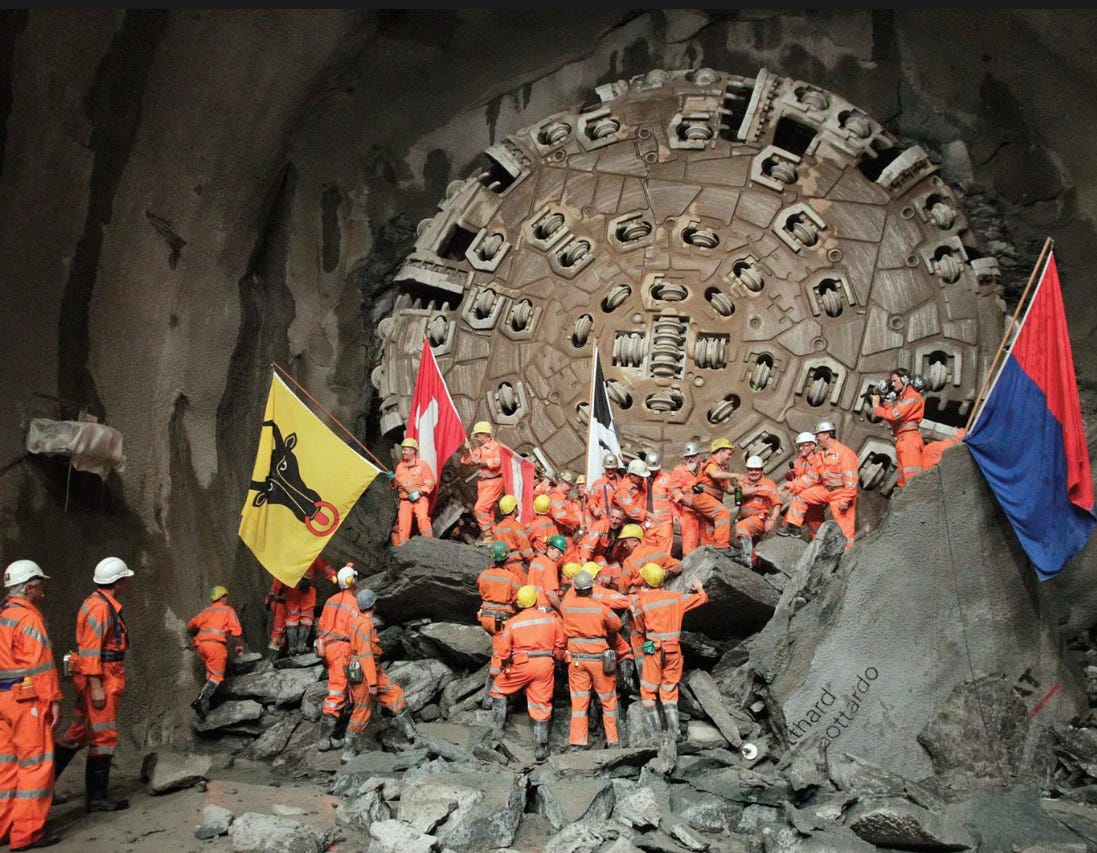
The Gotthard Tunnel is a two-part masterpiece, completed after 17 years of construction. The plan was for the boring machines to set their circular blades to the walls of the Gotthard Massif from both sides simultaneously — from the north and from the south. On the 15th of October 2010, the north and south teams of workers met in the middle of the mountain, as the last breakthrough crumbled dustily apart. And how far off were the two holes? Well, a full and generous eight centimetres was how much one of the teams missed the meeting point by. Which team that was belongs in the secret drawer of the Gotthard project. No, the workers were not boring by gut feeling. Otherwise they might just as well have become archaeologists or dentists. The engineers had called on help from above. That help goes by the abbreviation GPS, which stands for something like “God’s Positioning System.”
Oh, it doesn’t? It stands for “Global Positioning System”?
Well then.
In Erstfeld in the north and Bodio in the south, both targets were first aligned with one another. A tricky situation, since the people of Erstfeld speak a kind of German and the people of Bodio are under the impression they have command of the Italian language. Even so, they managed to lay a precise coordinate grid across the entire Gotthard Massif. A GPS system like that is good and useful, as long as the receiver hasn’t just disappeared into a mountain shaft. Once it has, GPS stops coming through — not even a flicker. That is where good old laser technology stepped in with its own system, reporting any deviations immediately to the drivers of the boring machines.
Sissi and Heidi — those are the names of the two enormous boring machines that made the tunnel through the mountain possible in the first place. Just before the meeting in the middle of the mountain, Sissi and Heidi were stopped. With a small pilot bore, the workers wanted to check whether the other side really did hold the continuation of the tube. It did.
The Gotthard Tunnel and the other 1,199 tunnels in little Switzerland have given the Swiss every reason to be proud of their tunnel vision. After all, people and vehicles no longer had to clamber over high mountains just to catch a glimpse of the other side.
If I am being honest: I do not like tunnels. As a voluntary practising claustrophobic, I do not enjoy moving through a tube. I was also often aware that above the tunnel, an immeasurably heavy mass of rock could take it into its head to crush the tunnel, right at the moment I was looking forward to an espresso on the piazza in Lugano.
The tunnel makes for a clear vision.