Undeniably?
Why would anyone give up on themselves and on the deniable? It happens so easily, when the fatalistic steps in and plants itself in front of denial as “un.” Ladies and gentlemen, the matter of denial is settled for good. Note the UN in front of denial.
To refuse — or to deny — is one of the options on offer when making decisions. Now how grand and well-behaved is that?
When did you last refuse something?
And why?
Or why not?
Two things tip over once the undeniable is allowed behind the wheel. On one hand, the status of the undeniable — that is, of not denying oneself — is the wheel itself. On the other hand, this giving-up is taken as a given. A fact that isn’t one yet. A person denies first, and then the consequences follow. Usually, anyway.
Once the word “undeniable” enters the game, the option has already marched into the history books.
Who actually decides when a situation gets labelled undeniable?
Is there a commission or a department for Undeniability?
I don’t know.
Of course there are natural laws that hold the fort for undeniability. Nature, after all, is famously not one for discussion. Especially not when physical laws — that is, undeniable reactions — count as facts.
After all, such regularities of natural law have been tested again and again, and checked off as “verified.”
Somehow it’s reassuring, being able to rely on natural law. Apparently nature doesn’t even know the word “corrupt.”
Or at best only by hearsay.
What would a world look like, if other laws too were held to be undeniable? I’m thinking here of universal human rights. Universally binding laws for the rights of man — would that be a moral natural law?
Good heavens, none of those laws could be denied, so they’d be undeniably valid?
No, they’d also be more or less unenforceable.
Now this way, now that.
Old Immanuel Kant undeniably knew a thing or two about that.
If these universal human rights proceed from morality and from reason applied absolutely, for instance.
Then they would be undeniably valid.
Is that so?
What would that look like, then? The same laws would apply to all people, regardless of skin colour, religion, origin, and appearance.
Well I’ll be, that sounds almost like a flyer out of Woodstock.
Peace and freedom included too?
Now things are getting pretty colourful around here.
Free speech is in the fine print as well?
International human rights law obliges governments to correct their conduct when they violate these human rights. They are also reminded to protect these universally binding laws on behalf of individuals and groups.
Or even to promote them.
Undeniably.
With this code of universally binding human rights, the UN wrote something bigger than any single government that signs it.
Yes, and reality is only too happy to deny this code — often right when it would matter most.
Oh, why do governments keep on denying people exactly these rights, time and again? Is there a Universal List of Excuses for violating human rights? That list would interest me no end.
I wouldn’t have an answer to that list myself, by the way — but I do notice how often it gets used.
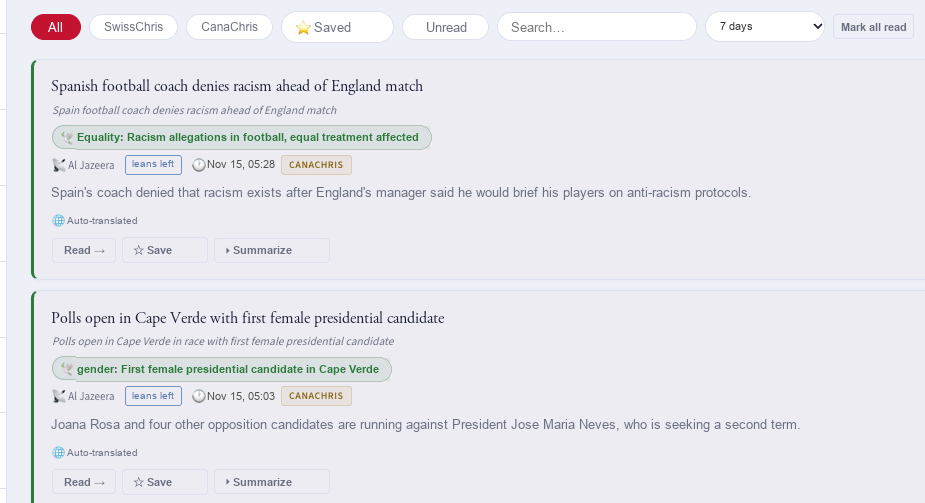
Every morning I sift through the news in my daily pool for that purpose.
This selection is handpicked, to get as wide a range of views and perspectives as possible.
And only from sources offered up by trained journalists. While sifting, I sometimes switch on this one green filter.
It holds a few surprises for flagging the news. On one side, there are the Universal Human Rights, and on the other, the philosophy of an aging hippie.
And lo and behold, how some report suddenly flashes the notice that one or more of those laws has been violated.
Yes, and suddenly article such-and-such gets flagged. Black on green.
I do want to keep learning, after all.
Undeniably.