


But only down in the cellar of the word — up above, in overholding, things look rather different.
Yet where is this overholding? That’s what I want to talk about today. Why?
Because I want to underhold (entertain) you, and perhaps myself as well.
Why do people entertain each other, or hold forth among themselves? Well, there’s curiosity about stories and information. Most members of Homo Sapiens-kind are affected by this.
What’s politics up to?
How are things in order over at neighbour Stettler’s marriage?
What, did the order get mixed up?
But entertainment can do much more than just exchange stories. In the old days, such people were called “conferenciers,” or simply entertainers. People who, for a few hours, made life pleasant, exciting, or downright delightful. Then a person becomes under-held. Through a conversation or a delightful evening.
So was that the original idea, when it comes to under-holding? No, it wasn’t.
The first idea behind building the verb “to underhold” was to support someone, or to keep something in working order, or to provide for it.
Oh, really?
Of course. Just think about why we speak and write of road maintenance, or maintenance paid through alimony.
That was the necessary, original version — maintenance making itself useful.
Only much later, somewhere along humanity’s long road, did the wish come along: to pass the time pleasantly.
Entertainment, on one hand, brings joy — and on the other, maintenance makes roads and lives safer. And safer.
So where is the word “overholding”?
If a conversation or a clown act can keep someone’s head above water, wouldn’t that term be fitting? The Duden shrugs its dog-eared shoulders. “Never heard of it.”
That’s odd. If a term begins with “under,” then surely its upper cousin, named “over,” should exist too. Suppose he did exist, just more hidden away — what would this cousin get up to all day long?
Overholding as a disposition? Language could stand to be a little more consistent: where one stands below, one should stand above too. Where there’s an Under, there should be an Over. Best case, one with holding.
This cousin is what I wanted to become, even as a child. As a teenager, I heard the question far too often: “What do you want to be when you grow up?” I didn’t quite understand the point of the word, and understood the questioner’s motive even less. “But I already am somebody!” my adolescent mind would protest, a little annoyed.
What’s more, the term “overholder” was already missing from the Duden back then.
Still, I had a clear picture back then of what my future could look like. I wanted to become an overholder. That is, a person who entertains people with holding, but without any need for recognition. No, not from the stage, but seen from the wings, or the background. In Basel, they’re called the “vom Daigg” — old, established money that stays anonymous and still manages to accomplish quite a bit. I’m not just thinking of the Oeris, since they’re known by name and occasionally caught in the spotlight of a donor plaque. No, I mean those anonymous, quietly amused people who make things better for everyone.
One example that comes to mind is the concert hall at the Stadtkasino. Whenever a tram came rattling down the Steinenberg and its wheels began to screech around the curve, the listening pleasure in the hall was over. This bothered a wealthy person in the audience too. For one whole summer, the tracks along the Steinenberg and around the curve toward Barfüsserplatz were torn up and cushioned with springs. The idea was that the tram’s vibrations would no longer be felt during a concert. In my mind, in my imagination, I can see that first concert after the tracks got their spring treatment, when not a single disruptive vibration clouded the pleasure. And that anonymous spectator in the hall enjoys the concert as pure experience. And nobody knows that this person made the new sonic pleasure possible: an overholder.
Overholders of all countries, unite — and cushion many tragedies.
That would have been my dream job.
I was only missing one thing: a fortune worth millions.
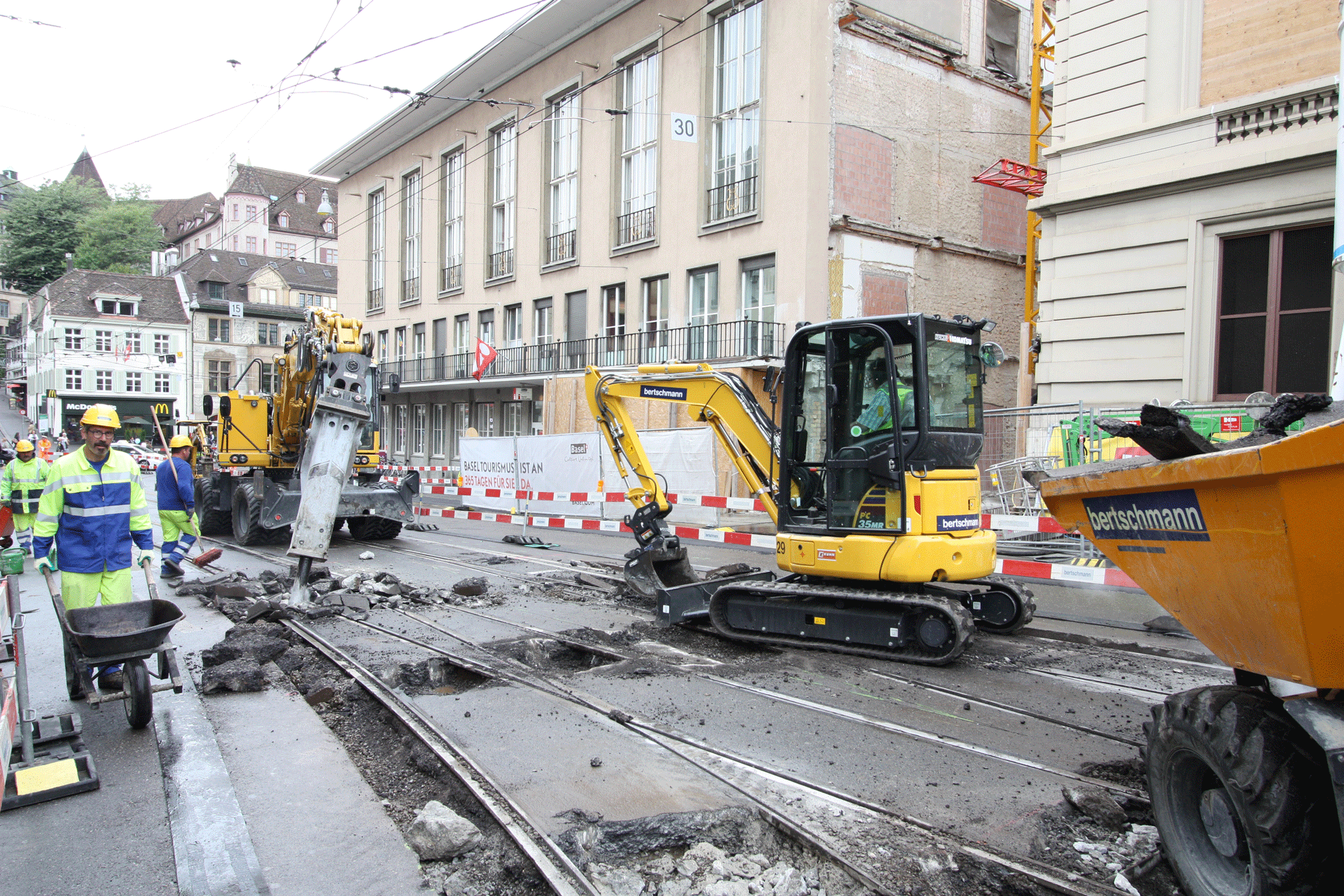
Tracks rebuilt at the Steinenberg in Basel, Switzerland by Bertschmann AG