


Who could ever have dreamed that the United States of America would manoeuvre itself into the fascist corner? Not me. Besides, I usually leave the dreaming to myself. Nearly every morning I ask myself precisely that question, when yet another outrage gets washed up from the south into my northern news feeds.
A few days ago, surprise gave way to curiosity. American historian Steven J. Ross caught me off guard with his new book, *The Secret War Against Hate*: fascism made in the USA never went away. It simply retreated below the surface — into the underground, to be plain about it.
And in that very American underground, things were simmering hard after 1945. Ku Klux Klan membership surged sharply as veterans came home to the States from Europe. Some of those veterans felt betrayed by their government — a discarded generation, in their view — because Jewish and Black communities had supposedly been favoured during the war. The drift toward antisemitism and racism had its renaissance. The road to White Supremacy was freshly paved.
The idea of an exclusively white American population? That sort of thinking turns my stomach.
In May 1945, in Midtown Manhattan, in the offices of the Non-Sectarian Anti-Nazi League, the Anti-Defamation League, and the American Jewish Committee, three spies wrote almost identical memos. “We can fight each of these hate groups as long as we take them on one by one. But if these groups ever find a way to communicate and cooperate with one another, hatred will be carried from the outer fringe right into the centre of society.” The internet and social media weren’t even conceived of as science fiction back then. Another horror scenario imagined by the antifascist groups was that the Nazi outfits might found their own political parties — or burrow into one of the major parties — and eventually seize the government through the ballot box.
What an absurd idea that was.
And this in a country of my old hippie dreams — Easy Rider and Woodstock?
Who were the four godfathers of White Supremacy back then?
Jesse B. Stoner, Emory Burke, James Madole, and George Lincoln Rockwell — four extremely white gentlemen in the league of the master race. One above all, Jesse B. Stoner, stood out across generations as the most influential figure of white supremacy. His “Christian Anti-Jewish Party” had one central aim: genocide of the Jewish population — and then the redistribution of the victims’ assets to white Americans. The man was known simultaneously as one of the leading bomb-makers and as a backroom operator throughout the South. Nearly one hundred bombings of synagogues, Black churches, and clergy residences appear to be his work.
A small anecdote about the eighteen-year-old Jesse B. Stoner, who suffered from polio. Before the war, he wrote to German doctors asking whether they could fix his leg. Their reply: “Yes — as soon as we have conquered America.” A response both pitiful and ice-cold in equal measure.
The other monstrous figure was Emory Burke. He led a group called the Columbians, who made a deliberate show of wearing uniforms styled after those of the National Socialists. The members also trafficked in an expanded rhetoric built largely around extermination.
But these groups had no free pass for their fascist ambitions. There were organisations like the Anti-Nazi League, the Anti-Defamation League, and the American Jewish Committee that had no intention of standing by and watching these movements do their worst. Or couldn’t.
One Stetson Kennedy infiltrated the Klan and the Columbians and produced weekly reports on whatever wild schemes these people were hatching.
René Fruchtenthal played with fire. He had himself hired by the Columbians as a secretary. He immediately took issue with the chaotic filing system. He proposed sorting it out. The Columbian leadership was delighted. Inside a cigarette lighter, René had a hidden camera, and over three nights he photographed around two hundred documents. The result? The leadership that had been so pleased with him was arrested on the strength of those very documents.
The resistance had teeth. And used them.
Yet a bitter taste lingers: were the United States, from the very beginning, also this — the United White Haters of America? This great land of freedoms, of immigrants from every corner of the earth, with its slogan of being the finest country on the planet?
The tactics of hatred have shifted over the past eighty years. The smoke-filled meeting halls of the forties became encrypted digital forums. But the psychological foundations of hatred have stayed the same.
Oh yes, this is still a Morgensplitter story. Meaning a story that only shares the same early-morning starting point. After waking at half past four and the first sip of hot coffee in my mouth, I wait for a word. No — I don’t wait. I let myself be surprised. This morning the word was “hatred.” Though, in my mind’s eye, I saw not just the word but a headline: “Hatred in the USA.”
Skimming through Steven J. Ross’s texts, my mood shifted into deep unease. And that feeling of powerlessness in the face of lurking, active movements of hatred is paralysing. That is why I couldn’t write a Morgensplitter story for two days. Just so you know.
But then it tips. The mood turns — from paralysis to an old, stubborn question: who pushes back? We do. The peace-minded citizens of a community of people who concern themselves with problems that already exist. Not those who generate new ones.
Yes, they’re out there everywhere. Politicians, academics, and ordinary people like us, with the idea of a democratically minded society.
The citizens of the United States of America are not a people of haters. But they contain large and ever-present traces of ideologies of hatred.
And that is the unsettling conclusion of one historian.
Democracy is not a self-sustaining experiment.
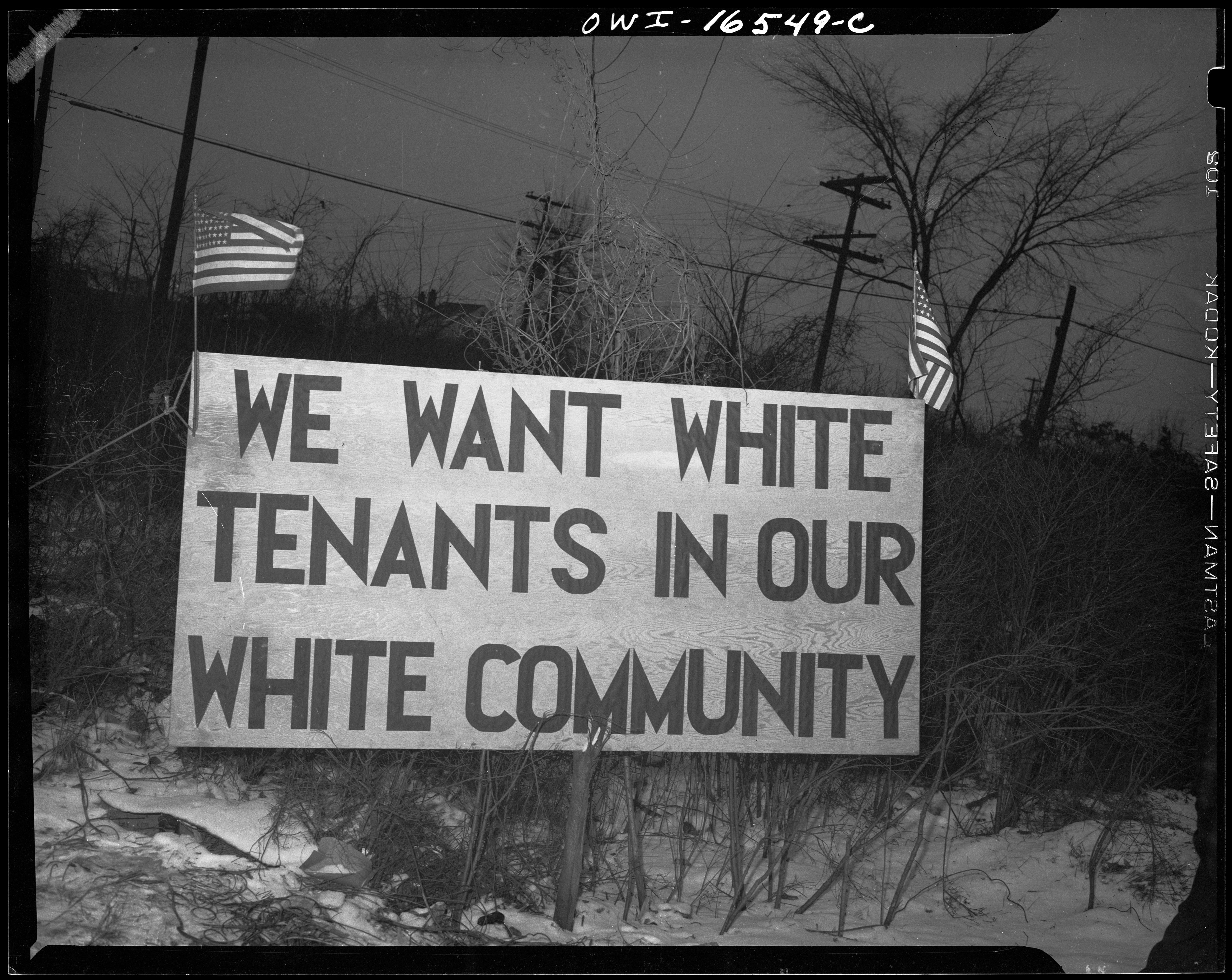
Arthur S. Siegel, Februar 1942. Library of Congress, FSA/OWI Collection, LC-USF34-fsa.8d13572».