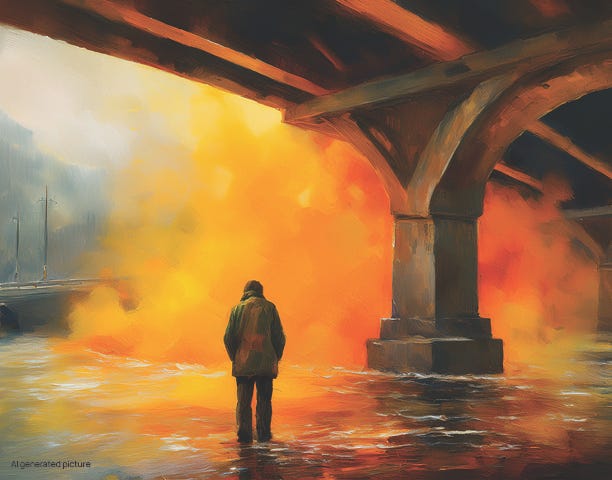
The thick air of recent days was homegrown — it drifted south from the massive fires burning across northern Ontario. Blowin’ in the Wind isn’t always a good idea.
The morning sky tipped into unhealthy shades of orange and yellow. The sun knocked against a murky broth. In vain.
Well-advised is anyone who owns a door and a few windows they can close. Harder hit are the people who currently have no house, no home to retreat to. They want to breathe without getting sick.
How do you wake up when you’re sleeping under a bridge and the air is yellow — and nobody has told you why? No phone, no explanation — just yellow air and eyes that burn. The eyes begin to water, breathing becomes a fight for clean, fresh air. There are shelters — temporary sleeping spots that promise warmth or clean air. These people hope a room will stay open during the day, too. For the people without a roof and without windows.
Staying outside makes you sick.
Paediatric lung specialist Kevan Mehta from McMaster Children’s Hospital describes the health risks in the currently smoke-laden air from the wildfires. When people already suffer from illness — which is common among the temporarily homeless — the burden of smoke in the air makes things considerably worse.
“Many health issues are tied to socioeconomic status and to what people have access to. Even now, we essentially regard clean air as a privilege,” he said.
Around 15,400 people in Toronto currently have little or no access to the privilege of clean air. Many of these people are homeless right now — a number that has more than doubled since 2021. That’s what the City of Toronto’s Street Needs Assessment survey, conducted in October 2024, shows. In Newmarket, too, the number has now nearly doubled, to close to 900 people.
“Clean air is a privilege!”
Climate change is placing new demands on those responsible for policy. More cooling spaces, N95 masks, high-performance air filters in emergency shelters — these bring immediate relief. Social workers going directly to encampments, too. But extreme weather events like these make a larger need plainly visible: social housing as core health infrastructure, for one.
Municipalities have established emergency plans for extreme cold and extreme heat, cushioning extreme temperatures — or poor air quality — with additional shelter spaces. In Toronto, a support plan for people is triggered when wildfire smoke and an air quality advisory are issued. The City of Kingston has a summer plan with protocols for supporting particularly vulnerable populations — including people experiencing homelessness — during extreme weather events. Air quality included.
Canada has known about extreme conditions with and from the weather for some time. But the response to the changing climate remains makeshift. The children and their children’s children are the groups who will live — and have to live — with the increasingly severe consequences.
I had long considered these scenarios as isolated cases or extreme situations. That’s yesterday’s story. The climatic changes no longer act alone — they interlock. Where it gets hot, the water disappears. Elsewhere, cities stand knee-deep in it. Yes, I worry about the children and their children.
The challenges are no longer exceptions. They are the new normal. How helpful would concrete and swift investments in climate protection be, for example? While we wait, the total cost of all the damage becomes enormously more expensive. And for many people, more deadly.
Yet the current frantic clamour for oil and gas pipelines seems to be part of the solution.
Appearances deceive — or sanctify the means of the lobbyists.