


Whoever falls will land — hopefully — on solid ground. Well, it wasn’t only human creatures that made me fall in love. There is so much more.
Besides Newmarket and Basel, there are two places on this planet where I have truly landed. The first step onto the volcanic black ground of Lanzarote: as if someone had switched planets and forgotten to tell me. Oh yes, I tried to describe it, but the impressions were too formative — too branded into me — to press what I had seen and felt into a keyboard or onto a sheet of paper. My first step in Barcelona had a similar effect on me, and produced a similar writer’s block.
My thought in both places was: “Can this really be?”
It was only later that I noticed the connection between Barcelona and Lanzarote. Two names, one master: Antoni Gaudí and César Manrique. Both artists turned to nature to learn from its variety and to shape their art from it. That is probably why you will find almost no right angles in the work of either man — nature is neither right nor angular. It is the opposite of everything a drawing board has ever thought.
Whoever allowed themselves to fall in love with Antoni Gaudí’s buildings in Barcelona understands the inspiration he drew from nature. The Casa Batlló shines with a façade that animates the cityscape like a dragon’s back. The Casa Milà looks like a rock polished smooth by the sea, and the Park Güell, with its curved benches of ceramic shards, feels more like something from a fictional world. And the monumental Sagrada Família: Antoni Gaudí built it for 43 years before he was run over by a tram.
Gaudí was a child sometime in the middle of the nineteenth century. A child who suffered from rheumatism. Since he couldn’t play with the other children, he began to observe plants, snails, rocks, and insects. Nature’s architecture knew no right-angled construction — yet it produced load-bearing structures of breathtaking ingenuity. The tree, with its branches, is an everyday example.
Besides nature, Gaudí was drawn to the Gothic and, above all, to the religious faith of Catholics. Pablo Picasso, for that very reason, could not stand Antoni Gaudí.
César Manrique might be Gaudí’s heir. Manrique was a sculptor and painter from Arrecife on Lanzarote. In the mid-sixties he flew to New York and made a name for himself as an abstract painter supported by Nelson Rockefeller. Whenever Manrique mentioned his home island of Lanzarote, the response was either a blank look or comments along the lines of “ah, that volcanic rubbish heap.” Manrique was drawn back to that very black volcanic island, and he swore he would make it one of the most beautiful places on the planet — before the rising tide of mass tourism could spoil it entirely.
César too took nature as his model. Where Gaudí used nature as the foundation for architecture, Manrique did the opposite. He built architecture into nature and made sure that nature had the last word. His remarkable home, Taro de Tahíche, sits inside five lava bubbles from a volcanic eruption; the Jameos del Agua is a collapsed lava tube into which he placed a concert hall, a pool, and a garden; the Mirador del Río is a viewpoint so nestled into the cliff that you can barely see it from outside. He called it “Arte-Naturaleza / Naturaleza-Arte” — art and nature as a cycle. Three colours, nothing more: the black of volcanic earth, the green of plants, the white of signposts.
Both men have sharpened my way of seeing, even though I never got to meet either Gaudí or Manrique. On the trail, I don’t march to get home quickly. I shuffle along at an interval pace. Or, in good Canadian: Stop & Go. That is why I find life itself, and mine in particular, thoroughly tree-mendous. These witnesses to the cycle of the year, standing around and swaying, may lose their leaves — but not one millimetre of their fascination. Yes, I am a wanderer among trees and clouds.
To let yourself fall in love feels extraordinarily natural.
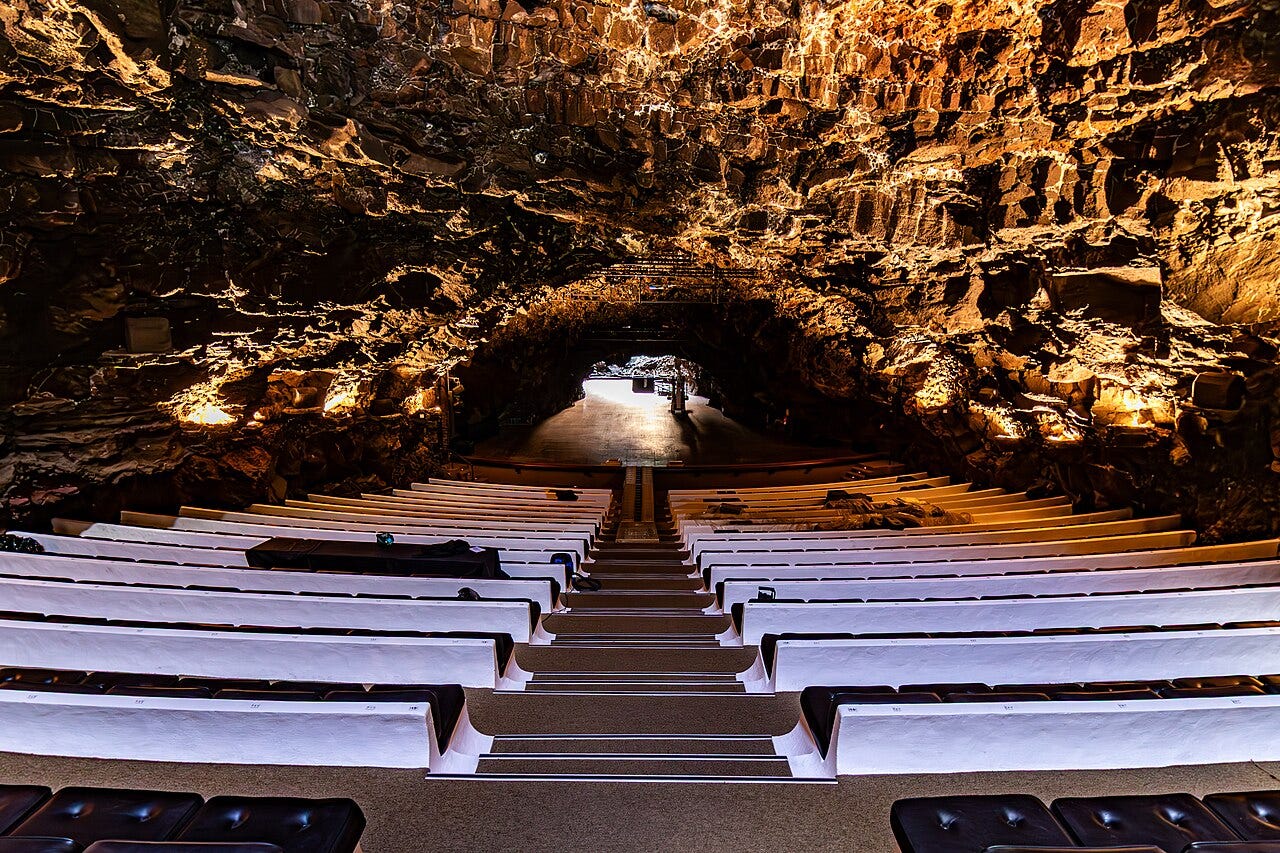
By MiljenkoSuljic - Own work, CC BY-SA 4.0, https://commons.wikimedia.org/w/index.php?curid=161237266