But does that mean long-timers have grown wise for temporal reasons — or have they simply grown white?
Perhaps that’s a question of the wisdom of the old versus the audacity of the young.
“Stop calling yourself wise.”
Ah, right. It’s like attractiveness, isn’t it. The people around you — others — are supposed to bestow such valuations upon you. When you do it yourself, it comes across as somehow odd and smells of narcissus.
Well, looks are externally determined from the very start, since genes hold an enormous share of the voting rights. What’s more, good looks eventually lose interest in themselves and hand over the reins to the appearances of ageing, as a matter of course.
The path to wisdom works in precisely the opposite direction. Genes have barely anything to say in the shaping of wise people. Or are there genetically predisposed babies? Well then.
Whoever feels called to wisdom and wishes to draw near to it: good luck. And staying power, ladies and gentlemen.
The road is long and paved with a tremendous supply of stumbling blocks.
What ingredients does it take to be regarded as wise at some point in advanced age?
Well, before we all go searching for the missing recipe, let’s have a look at world history — the past kind, that is. Not just for show. Which figures are considered particularly wise today, and if so, why?
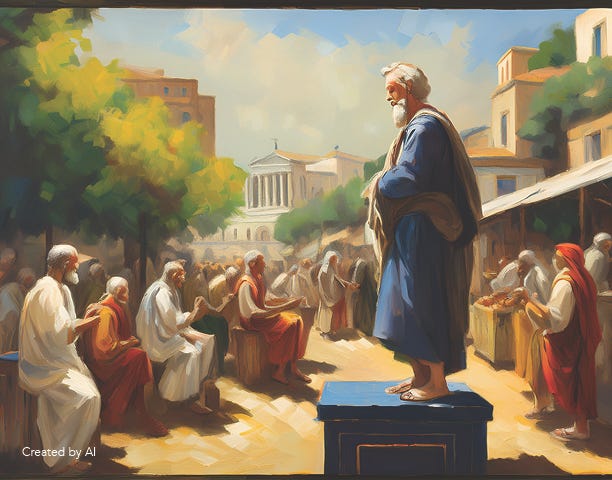
Naturally, the name Socrates surfaces immediately. The founding father of philosophy is credited above all with one piece of wisdom, when he said: “I know that I know nothing.” With that single sentence, the old philosopher incited millions of young people into irritating and relentless questioning. “Why is the sky blue?”
Socrates’ intellectual neighbour was Confucius, who had fallen in love with the early sport of ethics. A few rare qualities mattered enormously to him. Everyday things, such as respect for others, in order to generate a certain social harmony. And of course the measure of all things: some moderation when consuming whatever-it-might-be. And the people of Bavaria nod knowingly and smile.
An important spoilsport of Confucius was Laozi. He dedicated himself to precisely the opposite blueprint. He recommended, as wisdom’s final word, simply letting go. Allowing things to be — not intervening. Come again?
Now, the sages of antiquity may well have said — or rather written down — things that last. But aren’t they a touch too dusty and too old to bring some life into the department of wisdom in these thoroughly modern times?
There are indeed a few names who might count as important representatives of the wise.
Montaigne (1533–1592) — The man was quite simply the inventor of the essay, literally: the “attempt.” He withdrew to his château at 38, had quotations carved into his ceiling beams, and began writing about himself — about his kidney stones, his forgetfulness, his cat (”Who knows whether she is not playing with me?”). He took himself as Exhibit A for human nature, without ever taking himself too seriously. Now that I call genuinely revolutionary. His “Que sais-je?” — What do I know, really? — has the feel of Socrates, but with a smile. His wisdom? He watched himself think — and laughed warmly at what he saw.
Spinoza (1632–1677) — He got off to a rather dramatic start in life, being banished from the Jewish community of Amsterdam at age 23 and placed under a curse. His character could have turned bitter. Instead, he contented himself with grinding lenses for microscopes and telescopes. The man wanted to see more clearly, and he earned his bread by helping others do the same. When Heidelberg offered him a professorship, he declined: freedom of thought mattered more to him than a salary for thinking. He wanted to regard human actions “not with laughter, not with lamentation, but with understanding.”
A generation on, another continent — but the same school: Gandhi, Mandela, the Dalai Lama. They held to the insight that revenge is the only currency that leaves its owner poorer. Gandhi brought an empire to its knees by allowing himself to be beaten. Mandela invited his prison guard to his inauguration. The Dalai Lama calls the Chinese “my teachers of patience.” One can certainly argue how much of this was strategy and how much character. That very blurriness may be the point — for these people made virtue into a weapon against which there is no defence.
Václav Havel (1936–2011) — He was the imprisoned playwright whose works were celebrated in the West. His most famous thought concerns a greengrocer who puts the sign “Workers of the world, unite!” in his shop window — not out of conviction, but out of habit and fear. Havel’s point: dictatorship does not live by tanks, but by millions of small gestures of compliance — followers, in other words. “Living in truth” means leaving the sign out. In 1989, the prisoner became the president — and remained someone who rode a scooter through the corridors of the presidential palace. He seemed never quite to want to grow into the office — and that, precisely, was the plan. Somehow wise, that.
When you look at the powerful of this world — the political holders of powerful positions — very few fall out of the frame as “wise.” Should these decision-makers, charged with the wellbeing of their citizens, possess some basic element of wisdom? Or would that be more of a disruptive element? Perhaps audacity is a more important quality for surviving the fight in politics.
The wise person doubts himself and questions the world. The audacious one doubts the world and questions himself — well — rather less. Both carry themselves with confidence — only the wise person’s confidence is fed by what he has examined, and the audacious one’s by what he has ignored. Socrates knew that he knew nothing. The audacious one never received that memo.
The finest difference perhaps lies in pace: wisdom needs detours, audacity takes the shortcut. And because the shortcut gets you there faster, the audience readily mistakes it for competence — until the bridge collapses that the audacious one built without any structural calculations.
Bertrand Russell put the dilemma squarely: the clever are full of doubt, the foolish full of certainty.
Humanity has almost never declared its victors to be its wise ones. Socrates was executed, Confucius failed as a politician, Spinoza was banished, Mandela spent 27 years in a cell.
In hindsight, wisdom seems almost always to have been attributed to those who could have taken power — and didn’t.
Hey, hold on. Why are there no women’s names on the list of the wise of this world? Not a single one? Are wise women perhaps always standing behind the men, showing them the way to wisdom? Who’s wise enough to say?
What stopped women from being regarded as wise in old age? Well, the question is wrongly framed: “Who stopped them?” — Answer: nearly everyone who administered the writing, the stages, and the students.
Who was even allowed in? Wisdom does not sit on a shelf the way history counts it. The path to wisdom requires access, first of all — to education, to students, to writing materials, to public space. Socrates debated in the marketplace — a place where an Athenian woman had neither business nor business being. Confucius gathered students, Seneca advised emperors, Spinoza corresponded with half of Europe. Women with the same minds sat meanwhile in kitchens, cloisters, or marriages. Wisdom was present in abundance, but women lacked the stage, the parchment, and the students who wrote things down.
Who does history remember? Even where women thought and wrote — the decision always lay with the guilds of men in power. They decided what went into the books. The chroniclers, the church fathers, the universities, and the encyclopaedia editors not only trained students but constituted a closed men’s society lasting centuries. What women thought was often filed under a different label: “mysticism” instead of philosophy, “letters” instead of work, “muse” instead of thinker.
Women’s wisdom was not simply ignored — that would be fatal ignorance — it simply took other forms. In letters, in the raising of children, in holding communities together. It wasn’t overlooked. It was renamed — as cleverness, care, intuition. Same substance, smaller label.
With a little rummaging in one’s mind and digging in history, a few women’s names surface who count as Wise and as wise.
Diotima — the woman from whom Socrates himself says he learned what love is; whether historical or Plato’s invention remains open — what’s telling is that even antiquity only permitted a woman’s wisdom as legend.
Aspasia — teacher of rhetoric in Athens, who Socrates is said to have listened to; she is handed down to us mainly as “the companion of Pericles.”
Hypatia of Alexandria — mathematician and philosopher, murdered by a Christian mob; her fate shows what the first filter could mean in its most extreme form.
Rabia of Basra — 8th-century Sufi mystic who taught that God should be served out of love rather than fear of hell — centuries before similar thoughts arose in Europe.
Hildegard of Bingen — polymath who made it into the historical record only because the convent was the one niche in which a woman was permitted to write.
Murasaki Shikibu — wrote around the year 1000 what is perhaps the first novel in world literature, full of knowledge of human nature that any Stoic would have been glad to possess.
Émilie du Châtelet — translated and corrected Newton; Voltaire called her “a great man whose only fault was being a woman” — meant as a compliment, useful as a diagnosis.
Hannah Arendt — thought about the banality of evil at a time when everyone was looking for monsters.
Simone Weil — the philosopher who went into the factory in order to understand what she wrote about — lived consistency, at which a Seneca would have fallen short.
Etty Hillesum — wrote diaries in the transit camp Westerbork with a composure equal to that of the Stoics; she died in Auschwitz.
Wangari Maathai — planted trees against a regime and proved that patience can be political.
What connects all these names: wisdom was never a battle of the sexes, but of labelling.
I know that I am not wise. Only curious.