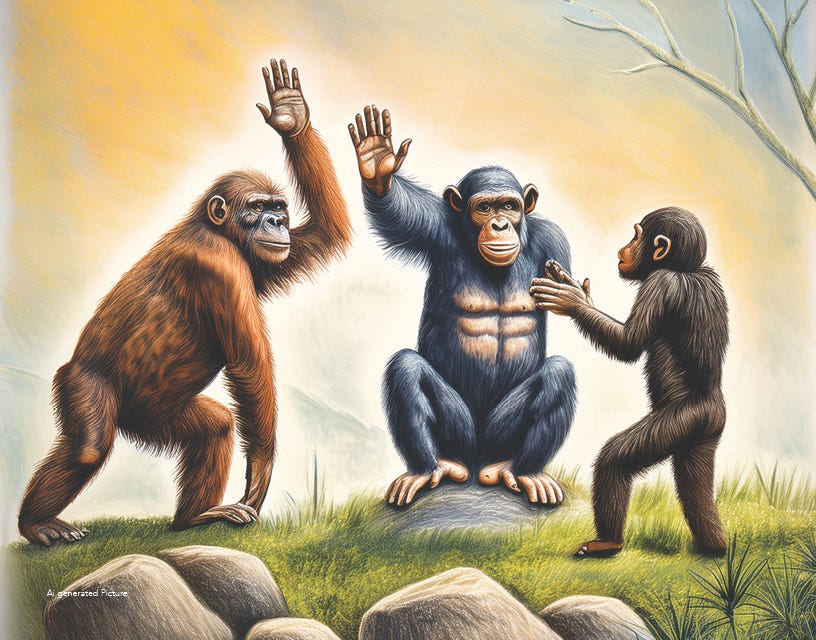
It took long enough for the folks out of the Neanderthal to even start thinking in the first place. It must have been sobering when the cauliflower in the head began expanding its thinking. The likely trigger of the Thinking+ moment was a decision by the chimpanzees, some six or seven million years ago, to split their evolutionary line. That’s when the humanitarian line began to take shape. Thinking came bundled with things related to planning itself and the use of tools. There were even a few small splinters of social calculation thrown in. And we’re still talking about the chimpanzee as such, before the splitting of the ancestral line even began.
“Don’t act so monkeyish” accordingly has a prehistory millions of years in the making.
And where does the wish fit in here? This is where the research gets a bit tricky. Because wishes weren’t being written down yet back then. Why’s that? Probably these ancestors simply weren’t informed about written language and the absence of its invention. Ergo, facts about wishes are hardly to be found. So, not at all.
Back to the chicken and the famous egg. Was it necessary, for a wish to form, that thinking got an upgrade first? After all, a wish first has to be able to form itself out of particulars. And what exactly does that take? Ah yes, forming. First the forming of brain mass on a larger scale, and then the forming of clear thoughts.
Oh my, how did Homo Erectus back then even notice when he crossed paths with a thought? Did it introduce itself politely? “Hello, I’m a thought.” “Thanks.” Or was the Erectus named Homo simply surprised by what was starting to play out in his head?
Well, evolution really took its sweet time with all of this. Which led to the very first folk saying ever: “Things were slower back then.” With time — lots and lots of time — the human line of Homo folks got better at getting used to their first thoughts.
Then greed came around the corner.
“I want to think better and faster than the others,” and lo and behold, the wish for superiority saw the light of the moment. And this wish promptly struck a pact with the gene of curiosity. I think (!) that this partnership of wish and curiosity shaped the very first words of human language. All the terms considered important back then began with the letter “W.”
What is that?
How does that work?
Why him and not me?
Wherefore do I think this way?
What’s this thing even for?
The W-line of Homopaths Erectus, Neanderthal, and Sapiens were, from then on, busy with the plague of questioning. That is, in the time left over between hunting, cleaning the cave, and making children.
As I said, evolution is an obsessive time-eater. She took her sweet time, for instance, waiting until about a hundred thousand years ago to develop the first teeny-tiny hint of symbolic thought. Naturally, the female half of the Homo community immediately insisted that the other half take charge of anything jewellery-related. Beaded ornaments and engravings adorned the cave walls. But it wasn’t until about 45,000 years ago that people back then stumbled upon art. They painted their caves with things from the world around them, and they began forming themselves into musicians.
At least that’s what Keith Richards says.
Evolution does seem to have learned a lot along the way. She did take plenty of time, after all. Today it seems as though thinking has, again and again, kicked it up a notch in speed. Speed-dating, Speedy Gonzalez, and speed as a substance of unwanted indulgence are all results of fast thinking.
Nonsense.
Fast thinking looks, at first glance, like a positive invention of evolution. Because with it, speed produces positive effects in many areas. Whoever can think fast will also react faster. To dangers. To solutions. To questions like “do you still love me?”
Sometimes I wish that “thinking things through to the end” would take its place ahead of “fast-thinking.”