


The employer is called Cleveland-Cliffs, and it had bought the Canadian company Stelco in 2024. The contract, above the fine print, contained a fair number of promises: keep the jobs, keep production, all told 34 conditions in total.
Then the layoff notices fluttered into the homes of Stelco’s employees, drafted and sent by the parent company Cleveland-Cliffs. The company said flatly, that it was honouring all its commitments. The government saw the matter in a different light – a contractual one.
Mélanie Joly steps onto the stage.
One can expect a fair bit from industry ministers like Mélanie Joly: handing out medals, cutting ribbons, smiling out from under a hard hat at plant openings. So much for the usual, in stereo. Minister Joly doesn’t see it that way, and she shows right away how differently she sees her job. She read the sale agreement, made a few notes – 34, at minimum – and then applied them. She called the company’s compliance report “far from satisfactory,” gave the leadership a 15-day deadline, and had the suits informed that there would be no conversation with the boss until a concrete recall plan for the layoffs was on the table.
No summit, no photo op. The workers first, the coffee after.
The result: all 175 employees return to their jobs on December 1st. Including pay for the time in between.
The company explains the decision with improved customer demand. So was this an economic turnaround – and not an admission that it hadn’t held up its end of the contract before?
The union says it comes down to consistent pressure from Ottawa. Both are probably right, the way a child who suddenly tidies their room might say both: “I was going to anyway” and “Mom was standing in the doorway.”
But the punchline of the story isn’t the recall – it’s the boss behind it. Lourenço Gonçalves blames American tariffs for the situation in Hamilton. The very tariffs meant to protect his business in the US. You can’t complain about the wall you helped build yourself.
At the same time, act two was playing out in Brampton, punchline included.
Stellantis builds cars under the brands Jeep, Jeep, Dodge, RAM, Chrysler, and plenty more. The company has plants in Canada, namely Brampton and Windsor, Ontario. Now, this company had been promised public funding for retooling its Brampton and Windsor plants: up to $529 million from the federal government, up to $513 million from Ontario. Mind you: up to.
Paid out by the end of the 2024/25 tax year, according to federal documents, was a good $222 million, for both plants combined.
Ontario says that, as for Brampton, nothing at all has flowed yet.
Money that never arrived can be neither clawed back nor kept.
Then the Jeep Compass wandered off – no, drove off – to Illinois, no replacement model was offered for the Canadian branch, ergo the plant sat idle. Ottawa sent an urgent notice titled a default, neatly and properly numbered with four points. That’s how an agency that’s done its homework operates.
Stellantis then offered $24 million in repayment. Ottawa stated, matter-of-factly, that it was more a matter of “hundreds of millions.” Price gaps that drastic are otherwise only seen between the hotel minibar and the supermarket.
And then the move no screenwriter would dare write: Stellantis sells the plant to Roshel, a Canadian manufacturer of armoured vehicles. Premier Carney called it “outrageous,” the union Unifor speaks of betrayal. How much Ottawa knew beforehand is, incidentally, disputed – the reports contradict each other. I’m leaving that open on purpose. A column is not a courtroom.
What remains. Joly resolves, Stellantis stays open.
You don’t have to like Mélanie Joly to respect how consistently she acts: she reads a contract the way one really ought to always read one – as a promise, not as paper. That sounds banal, and it’s almost revolutionary in industrial policy. Whoever takes public money, or buys a company along with employment promises, shouldn’t later act surprised when someone asks about the results.
We Swiss know this game from the other side. With us, a location is rarely defended loudly – more often it’s quietly wound down, with a press release on a Friday afternoon. That here a minister, with a charming smile, sets the deadline, applies the pressure, and in the end 175 people return with pay – that’s not a hero story. It’s much better: proof that a contract can be more than decoration.
What remains open is the question hovering over both cases: who is liable when the decision gets made in a boardroom, and the consequences land in Hamilton or Brampton?
Until that’s sorted out, I’d recommend the same thing to all of us: before signing, read the contract thoroughly. Especially the fine print.
After signing, make sure someone enforces the contract’s terms.
And when in doubt, know someone like Mélanie Joly.
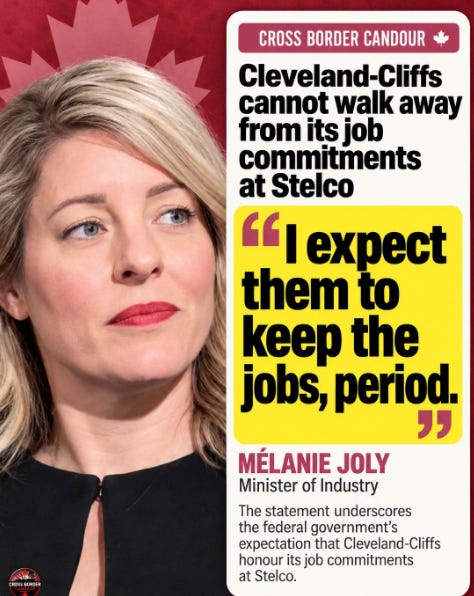
Photo: Cross Border Candour
The contract is not in my hands.
The news outlets, all I have to go by, state that the contract is full of redactions.
The Liberals, our government as a whole, has a poor track record when it comes to being transparent.
Without transparency there can be no trust.
No trust means nothing she says can be believed.
I say, stop giving away money we don't have.